






Mobile users check their devices around 144 times daily. That means you have more than 140 chances per day to attract their attention. Of course, provided that you offer relevant services to the relevant audience. Sounds promising and challenging at the same time, right?
When it comes to real estate businesses, mobile app development seems an optional move. You already have a website, a loyal audience, and a huge amount of work done under your belt. However, in 2026, when app users generate 3.5x to 7x more revenue than web users, ignoring mobile apps means leaving a significant share of revenue untapped.
Today, we will discuss real estate app development through the eyes of business owners and strategists. Keep reading to explore the industry situation, reasons to invest in mobile solutions, real estate mobile application types, and some inspiring examples of real estate companies that conquer the market.
What’s Waiting for Real Estate App Investors? Key Market Insights
2026 seems to be a perfect year for investing in real estate app development. On the one hand, you can learn from the experience of companies that started earlier. On the other hand, there’s still an opportunity to establish a strong presence in the growing real estate app market.
Every day, some business becomes a proud owner of a real estate software solution. In 2024, the total value of real estate software solutions was $11.2 billion. In 7 years, it’s expected to almost double, reaching $22.5 billion.
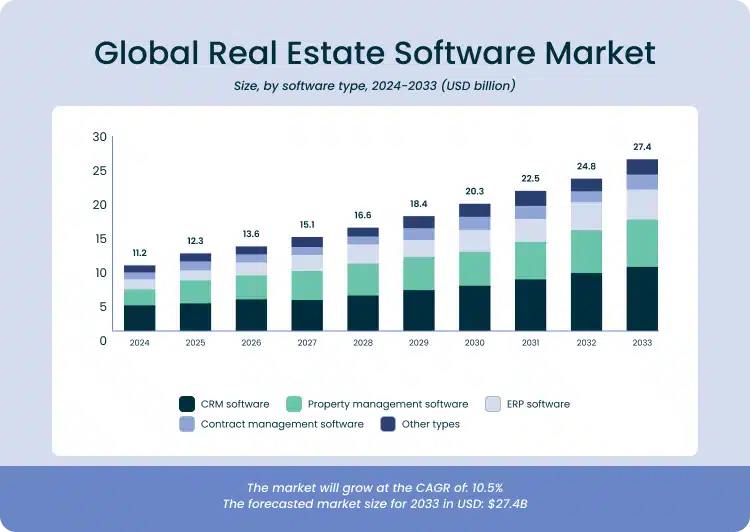
Thus, the real estate sector shows no signs of slowing down. And there still exist a lot of problems that real estate application development can solve. These include:
- Fragmented property information. Users often struggle to find comprehensive listings in one place.
- Inefficient communication. Buyers, sellers, and agents face delays due to scattered messaging channels.
- Complex paperwork and transactions. Handling contracts, financial transactions, and approvals is often slow and error-prone.
- Limited personalization. Most platforms offer generic recommendations instead of property suggestions based on user preferences.
- Poor user experience on mobile. Many real estate services are not fully optimized for smartphones, leading to frustration.
- Difficulty comparing options. Users lack intuitive tools to evaluate properties, neighborhoods, or financing side by side.
A well-designed mobile app can address these pain points, streamlining the process and delivering a smoother, more engaging experience for all parties involved. Get in touch with our team to receive a detailed consultation on the features of your future mobile app that will best solve your customer pains.
Real Estate in Your Pocket: Why Leading Businesses Invest in App Development
Now you know that real estate mobile applications make clients’ lives easier. And what about businesses? In fact, investing in real estate mobile app development gives companies a number of benefits, too. Let’s go through them:
1. Boosted customer engagement
Since the phone is always close to the client, creating a mobile application gives you multiple opportunities to stay connected with them and continuously engage them.
Push notifications, chatbots, and gamification elements of the real estate app development solutions all help literally hold the client’s attention. Combined with effective marketing, they drive clear business growth.
2. Leading market positions
While your competitors are still stuck at the level of basic websites, you have a great opportunity to take a leading position by building an innovative application. Just five years ago, implementing AI in real estate application development sounded out of reach.
Today, every second app includes AI or virtual reality technologies that help personalize the user experience, making the customer journey easier for them and delivering higher conversions for you.
3. Budget recoup
In addition to all these great benefits, you also have the chance to effectively recoup the investment in the real estate app development solutions.
You can use different monetization strategies for your app, such as adding premium features, subscriptions, early paid access, and others. In this way, you will earn money while delivering an excellent user experience to property buyers.
4. Simplified operations
Real estate application development simplifies the behind-the-scenes work of your business, including document management. It provides a single and secure place to store and manage different document types, significantly saving your team’s time and resources.
5. Improved lead management
Unlike traditional methods, tracking user activity in applications allows you to more accurately monitor potential customers and leads, nurture them in a personalized way using smart technologies, and ultimately achieve more closed deals.
Want to Experience These Benefits in Practice?
Get in touch with our team, and we’ll help you develop the best plan for your mobile application.

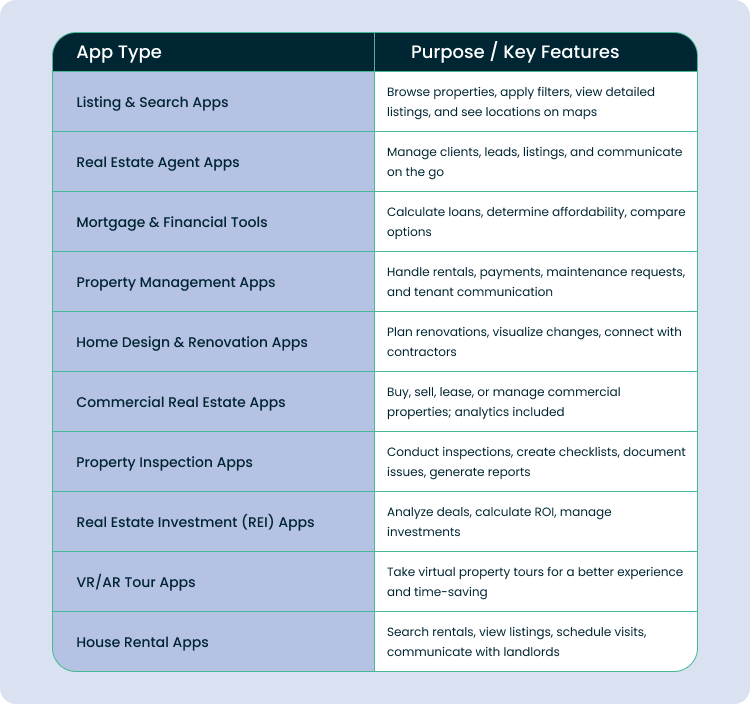
10 Main Types of Real Estate Applications
Before jumping into real estate app development, it helps to step back and ask a simple question: What exactly should your app do? Most successful real estate apps don’t try to do everything at once. Real estate application development should start with a clear core use case and expand over time. For example:
- A listing app can evolve into a marketplace
- A property management tool can add financial tracking
- A rental app may introduce virtual property tours
That’s why your best strategy is to choose the key purpose and then scale your app step-by-step. Here are the main types of real estate mobile applications and core functions you can focus on:
What Real Estate App Features to Prioritize and Which Ones Are Optional?
Now comes the part everyone is usually excited about and slightly overwhelmed by. Features of the real estate app development solutions. It’s tempting to pack everything into your app from day one. But the smartest products don’t start big. They start useful and then grow.
A good way to think about features is in three layers:
- What you must have
- What makes you competitive
- What makes you stand out
Let’s break it down.
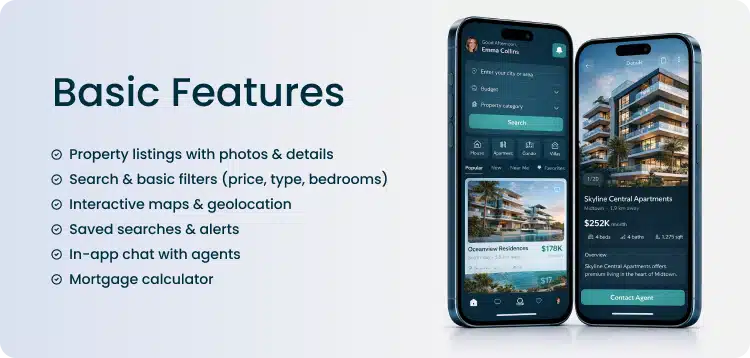
Basic features: real estate mobile app foundation
This is your app’s “it just works” layer. Nothing fancy, but absolutely essential. These features of real estate app development solutions cover the core user journey: search → explore → evaluate → contact.
Skip any of these, and the experience starts to feel incomplete. Like a house with no front door. Here are some examples of the basic real estate app features:
Nice-to-have features: your competitive edge
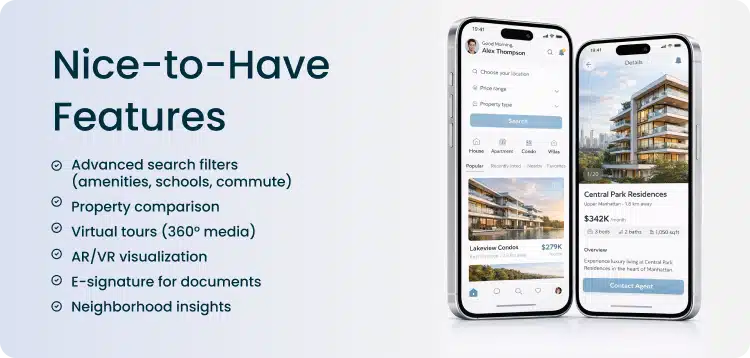
This is where your app stops being just functional and starts being convenient. These features reduce friction and decision time.
Instead of users jumping between tools, tabs, and platforms, your app becomes a one-stop decision hub. And that’s exactly what keeps them coming back. Let’s look at the nice-to-have features in detail:
Custom features: your differentiator
Now we’re entering the territory where real estate app development solutions become more than tools. They become branded products. This layer is where real competitive advantage lives.
At this point, you’re not just helping users find properties — you’re helping them get valuable insights and make smarter decisions faster. These are the examples of the custom features worth your attention:
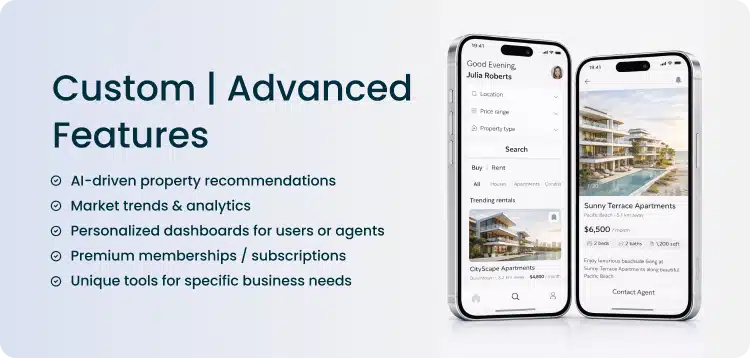
So, when building a real estate mobile app, start with the essentials that make your solution genuinely useful. Layer in features that simplify decisions and save time. Then, once you understand your users, invest in capabilities that feel almost tailor-made for them.
The goal isn’t to build the most complex app. It’s to build something people don’t want to close.
If you’re not sure which features make sense for your specific case, it’s worth getting a second opinion. The team at Forbytes can help you shape a feature set that aligns with your business goals, user needs, and budget. Contact us to get a feature breakdown and an estimation.
How Much Will Real Estate App Development Cost You? Factors to Consider
The total cost of your real estate mobile application depends on many factors. These include:
- App functionality
- Custom design
- Technology stack
- System integrations
- Team composition
- App maintenance and updates, etc.
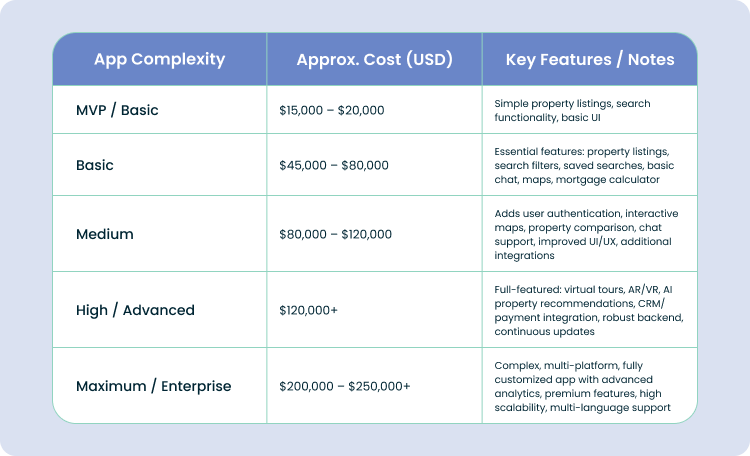
The more work required on your solution, the higher the cost. This way, simple real estate app development solutions with basic features may cost you around $15,000. Meanwhile, a feature-rich, advanced app can take even $120,000+.
Below, you can see the average price breakdown for real estate applications:
However, it may happen that your app type and the chosen features are out of your budget. Then, look at the tips that our real estate experts prepared for such cases:
- Start with MVP. MVP development allows you to test the viability of your real estate app idea and the actual need in your application among the target audience. If the results are promising, then you will move to full-scale app creation.
- Outsource real estate mobile app development. Partnering with offshore or nearshore teams significantly cuts project costs. You get access to high-level technical expertise for the lower price, maintaining your app quality.
- Use cross-platform frameworks. If you need an application for several platforms, frameworks like Flutter or React Native can reduce the development time and be much more efficient than native development.
How to Earn More than You’ve Invested in Real Estate Application Development
Investing your budget into real estate apps can and should bring you money back. And even more than was invested. You have several options to make it possible:
- In-app fees. When completing a transaction via your app, users will be charged some part of the property’s sale or rental value. Usually, the percentage is low and acceptable by users in exchange for the security and speed of the transaction.
- Subscription-based model. Real estate professionals can offer some advanced features or exclusive services in the paid subscription model. This can include early listing access, AI-powered features, virtual tours, and others.
- In-app ads. When scrolling through property listings, your app users will see targeted ads for the services related to the real estate industry. For example, ads of the moving companies, local businesses, mortgage lenders, etc.
- Affiliate marketing. Another way to earn from the real estate app development is to cooperate with relevant businesses. If app users engage with the partners, real estate agents earn a commission.
- Lead-based model. Similarly to the previous option, you cooperate with businesses, charging a fee for each lead. Once a lead makes a successful transaction on your partner’s website, you get remuneration.
To choose the best monetization model for real estate app development solutions, conduct real estate market and audience research. Based on the data, you will find out the options that work best in your real estate domain.
What’s more, there exist rules according to which each monetization model should be implemented. If you choose in-app ads, then you should know about pop-up limits so as not to overwhelm your audience with annoying content.
Or, when you opt for a subscription-based model, plan out the free trial effectively. By doing so, you will present the value users will get from paying for extra features.
Forbytes can help choose, test, and implement any modernization method effectively. Get in touch with our team to receive a free analysis of your app and a proposal for the best monetization strategy.
Examples of Businesses that Created Successful Real Estate Apps
Looking for some inspiration before starting your real estate app development project? Hopefully, there are many examples of real estate apps that have won the market. Here are the top 5 US-based app cases:
- Realtor.com. Not just listings, but speed. The app is known for near-real-time updates sourced directly from MLS databases.
- Homesnap. Built for instant gratification. Snap a photo of a house and unlock property details within seconds. It turns curiosity into data.
- Zillow. The data heavyweight. Zillow doesn’t just list homes, it predicts, estimates, and visualizes market trends.
- Redfin. A brokerage with tech DNA. Redfin combines app-based search with salaried agents and lower commission models.
- Apartments.com. Focuses heavily on user experience for renters, with layered filters, 3D tours, and neighborhood insights.
Want Your Solution to Be on the List of Top-Rated Apps?
Book a call to get a plan for your real estate mobile app project from our industry experts. No obligations, no strings attached.
Build Your Real Estate App with Forbytes
After reading this article, you know everything about real estate mobile development. The next step is to plan out the project effectively to minimize risks, protect your investment, and get the best ROI. This is where our real estate app developers can help.
Forbytes has 15+ years of experience in custom software development. Our deep industry knowledge is combined with technical expertise and a risk-reduction approach. Contact us for the initial consultation on your future project and get a prompt response from our real estate experts.
Share:
-

-
-
Successfully copied
-


Anzhelika Danielkievych
Author
My mission at Forbytes is to help our IT experts share complex information in plain language. The articles we produce reflect our expertise and help readers keep pace with the market trends and insights. We strive to educate, inspire, and empower our audience through compelling content that tackles the intricacies of the IT world and makes it accessible to all.
FAQ
How long does real estate mobile app development take?
Your timeline will depend on many factors, similar to the project costs. The more features you need to create and the fewer people you have on board, the longer your development process will last.This way, the basic application can take between 3 and 6 months to create. In our practice, real estate businesses that opt for mid-level apps spend 6-9 months building them. Lastly, advanced solutions may take 1 year or more to implement.Get in touch with Forbytes consultants to receive a free project estimate for your unique case.
What tech stack is used for real estate application development?
The precise tech stack varies from application to application and totally depends on your app’s purpose and features. We may give you a rough example of the tech combination that can be used in real estate mobile app development. It involves:
- Backend: Django, Node.js, Laravel;
- Frontend: Kotlin (Android), React Native, Swift (iOS), Flutter;
- Database: Firebase, PostgreSQL, MySQL;
- APIs & integrations: Stripe for payment gateways, MLS (Multiple Listing Service), Twilio for messaging, Google Maps API.
What are the reasons to build real estate app development solutions?
You expand your audience, boost brand reputation, and get more control over user experience. By creating a mobile application, you strengthen the connection between you and your clients, increasing the time they spend on your services.
What aspects affect the cost of real estate mobile app development?
There are numerous aspects shaping the cost of your application.These include app’s complexity (how many features you need and how advanced they are); UI/UX design complexity (whether you use the templates or create custom designs from scratch); mobile app architecture (whether you build for one or multiple platforms and how many integrations are needed), and more.Our real estate development team can calculate the precise cost of your application. Contact us to provide app details, such as required features, timeline, preferable budget, etc.
What future technology trends to expect in real estate app development?
The real estate app development market will keep growing, strengthened by the following trends:
- AI-driven personalization. Instead of generic and filter-based listings, users will use highly personalized property recommendations that are based on their app behavior, personal data, preferences, etc.
- Immersive virtual property tours. Interactive 360° walkthroughs will ensure users feel like they are visiting the property. Highly detailed overviews will help make the right purchase decision, cutting the need for physical visits.
- Predictive analytics. Artificial intelligence and big data in real estate will help buyers, sellers, and agents anticipate market shifts, including price trends, neighborhood growth predictions, risk assessments, etc.
- Location intelligence. Users will explore lifestyles, not just real estate listings. Mapping will go beyond pins and involve dynamic walkability scores, crime and school data overlays, real-time transit and noise analysis, and more.






Let's Get in Touch




Forbytes created an app that allowed users to quickly measure themselves to be fitted for custom shirts. As a result, we could increase our speed, quality, and shirt output per week. Forbytes was dedicated to delivering a solution that accurately addressed our needs.

Forbytes’ engineers and team leads worked as part of our RnD group and were directly managed by our company directors. They were both proactive and adaptable, qualities that perfectly match our needs in our fast-growing and constantly evolving environment.

Forbytes has a strong process-oriented way of leading the company, with good respect for themselves and their managers. They made a choice not to become too big but build slowly on more qualified people, which is paying off.

Niklas Hammar
COO & Business
Development at Offerta.se

Our e-commerce site saw online inquiries and orders rise after working with Forbytes. The team used top-notch expertise to inform their suggestions and improvements. Constant communication, quick responses, and prompt delivery made for a smooth and enjoyable collaboration.

The Forbytes team was very professional and demonstrated a great understanding of the business aspects. All tasks were completed above expectations. Their experts were always available, and we never needed to wait for a response or a suggested solution.