
Education generates tons of information every single day, from how students interact with lessons to where they get stuck and what helps them move forward. The challenge isn’t collecting this data anymore. It’s making sense of it. That’s where big data in education becomes genuinely useful: it helps us see what’s actually happening in the learning process and make decisions based on real evidence, not assumptions.
Being able to process large data sets also gives us a clearer picture of how the system is developing. We can spot patterns, understand why certain issues keep repeating, and model what needs to change to make learning more effective.
In this article, Forbytes experts look at how big data in education can strengthen learning systems and help you build solutions that support more students and ensure better academic results.
Big Data in Education: What It Really Means
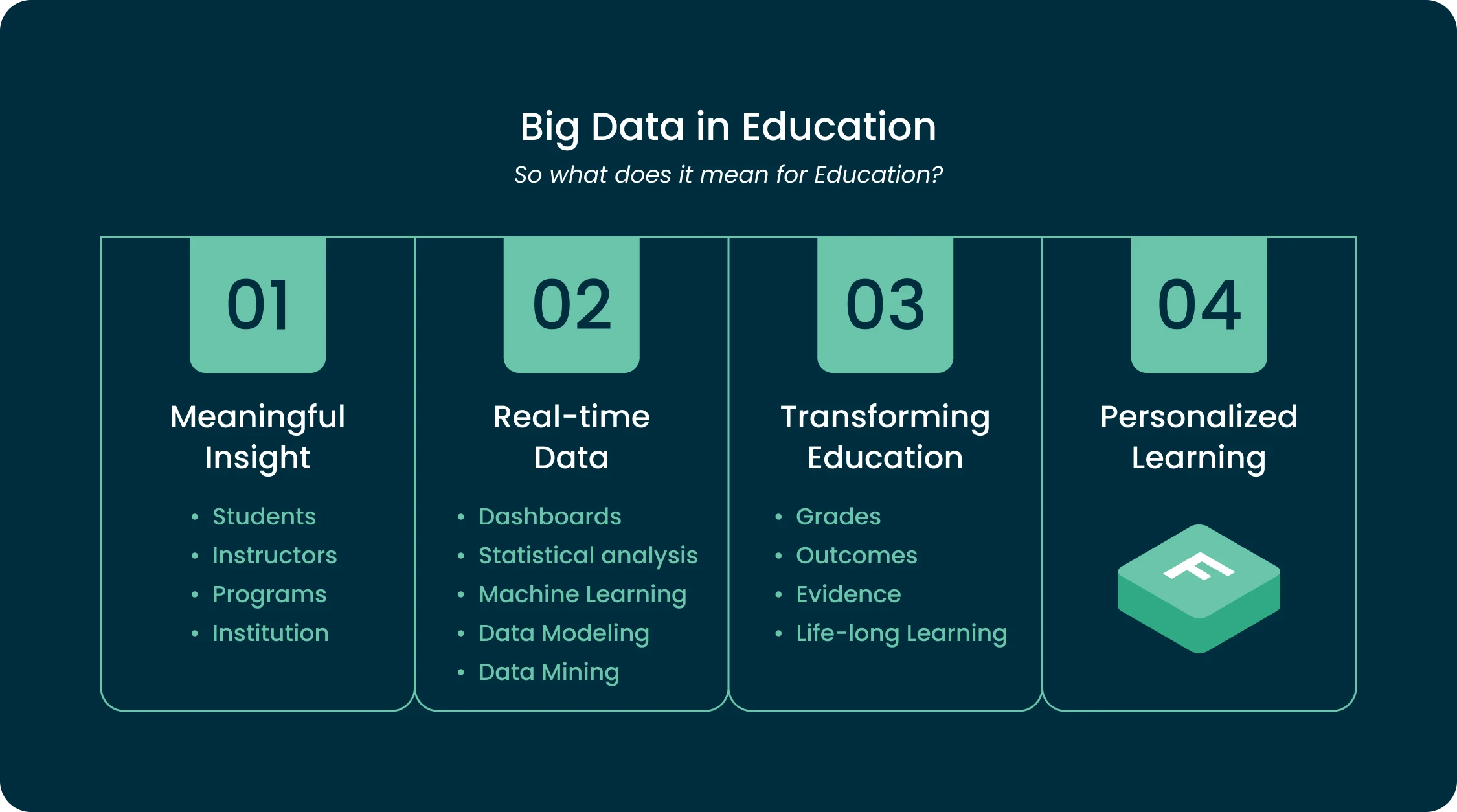
The ongoing fourth “educational” revolution requires a revision of the traditional educational imperative, which implies a rethinking of such concepts as effective learning and subject learning, as well as going beyond the educational model of transferring knowledge from teacher to student.
The operation of big data in education is about in-depth analytics of the educational system. This includes the measurement, collection, analysis, and presentation of structured and unstructured data of huge volumes about students and the educational environment. Such insights help understand the most relevant features of the functioning and development of the learning system.
A big data-powered system collects a very large amount of historical data. The question of how to process them in an accessible way is solved with the help of the wider use of communication technologies. But let’s explore the topic of big data in education from the beginning.
What kinds of data are used in education?
Quantitative and qualitative approaches are used to extract and research big data to get the picture that allows you to make more informed decisions. These decisions can affect existing business models, the effectiveness of teachers, as well as the academic results of students. On top of that, the info obtained can help improve the technological systems of educational institutions all around.
We can identify five particular types of big data in education that are employed for the above-mentioned goals:
- personal info;
- info about student interactions with digital learning systems (e-books, online courses, etc.);
- learning materials effectiveness reports;
- administrative (system-wide) data;
- forecast input data.
Based on the analysis of a variety of approaches and models, it is possible to identify the main areas related to:
- Thinking (primarily critical and creative);
- Interaction with other participants in the process (communication and collaboration);
- Self-regulation, self-organization, and reflexivity.
The results of big data analytics in education are most valuable when they reveal anomalous and borderline states of the system. This allows you to develop regulatory measures as a reaction to negative conditions, which helps enhance the development of the learning system.
The Impact and Role of Big Data in Education
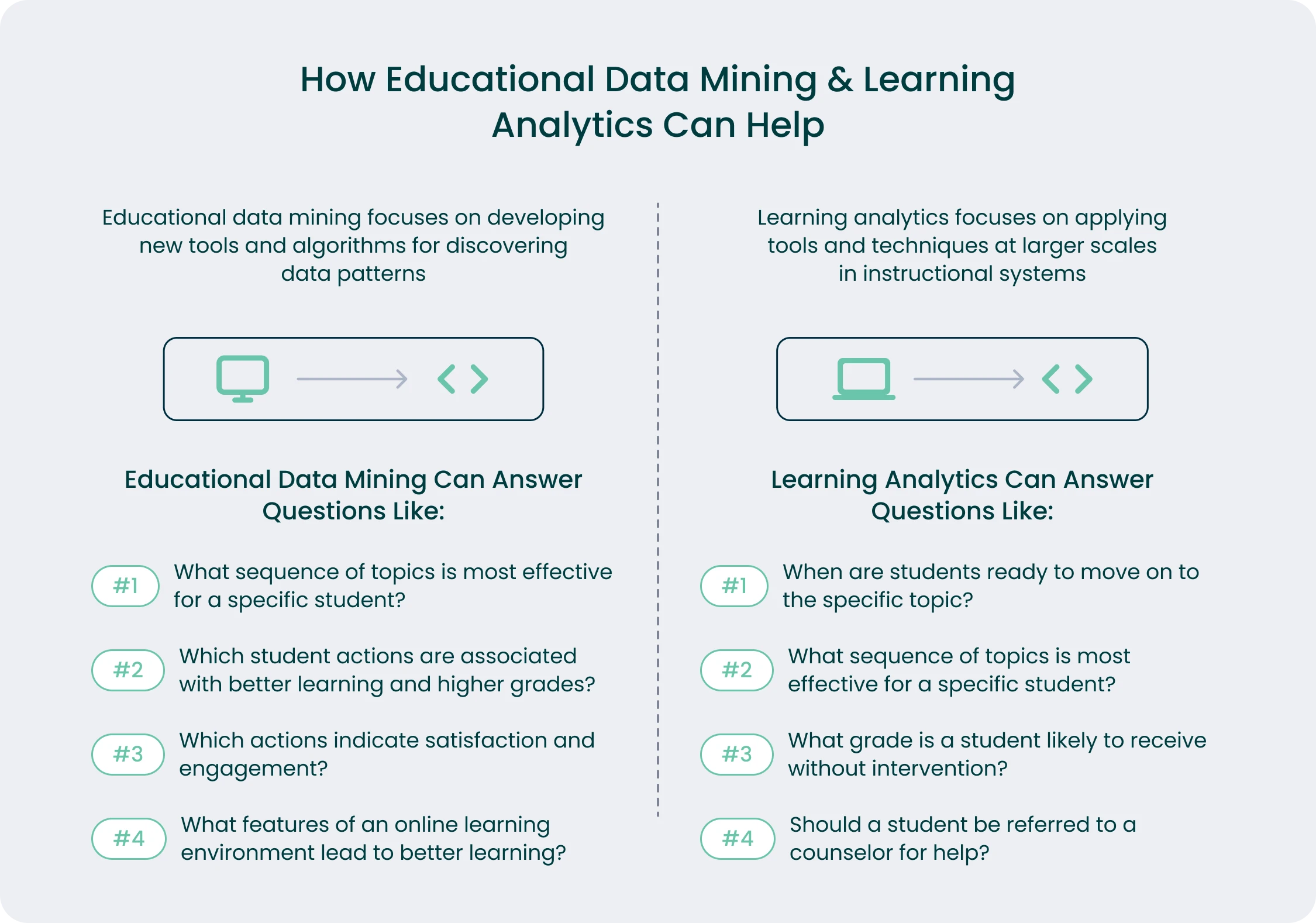
Big data in education provides academic institutions with the opportunity to integrate critical platforms and applications that are often used to manage various aspects of their work. This allows them to improve their efficiency and, ultimately, significantly reduce costs.
Technology itself is changing the way we analyze information and make decisions in areas such as academic performance, technology effectiveness, faculty, and organizational interaction. This makes it possible for students to build an individual educational trajectory in a new way, as well as assess the quality and choose an acceptable way of learning.
Academic performance
Professors use big data in research on student achievements and identify potential opportunities for more in-depth participation in processes. For example, they can analyze dropout rates, total enrollment, and student achievement rates to optimize the curriculum.
Teaching efficiency
Teachers can use the information received to create a more productive learning environment and the most effective assessment of the results and quality of the lessons. Analytics can provide real-world insights into quiz errors, incorrect student responses, and time spent on completing assignments. This allows teachers to adjust their instructions as needed and ensure optimal student outcomes in the short term.
Organization of processes
With the help of CRM, you can track the activity of potential students online, across social networks and mobile devices. When a potential new student visits the college’s web resource, “cookies” can be used to retarget ads to them on other websites. This can help increase the actual number of students and, accordingly, boost profits.
In-house progress
Technology also contributes to the efficiency and productivity of financial and business operations on campus. For instance, parsing network logs significantly reduces the response time to support requests. This encourages students to study better, which in turn has a positive effect on the image of the educational institution.

How Big Data Is Shaping the Future of Learning
The study of the accumulated information allows you to learn everything about the system at any time. A person is also a system that you can analyze, adjust according to parameters, and make out patterns for predictive analytics. For example, if we take any study group, we will certainly find in it students with different levels of training and academic performance.
For them, the setting of the curriculum may be set differently. Teaching in this case shifts from dry theory to learning with practical modules, and in the future, this should become the task of a virtual teacher powered by artificial intelligence (AI).
Planning
As data collection and analytics tools improve, administrators are getting more information to make predictions and informed decisions about student admissions. This can help drive growth in a targeted manner and plan the use of resources at the scale of specific training programs and not just the organization as a whole.
Expanded opportunities
The technology allows you to create individual training programs using a variety of online resources. Intelligent automation makes it possible to create assignments using learning management systems (LMS), giving teachers more time to focus on work directly in the classroom.
Incorporating AI, the Internet of Things (IoT), and virtual and augmented reality into curricula will drive personalized learning and improve student outcomes. They will also drive the further growth of big data. Technologies such as 5G networks and blockchain will provide academic institutions with a framework to handle growing traffic demands, increase fast transfer capabilities, and fully guarantee the security of any student records.
Benefits of Big Data in Higher Education
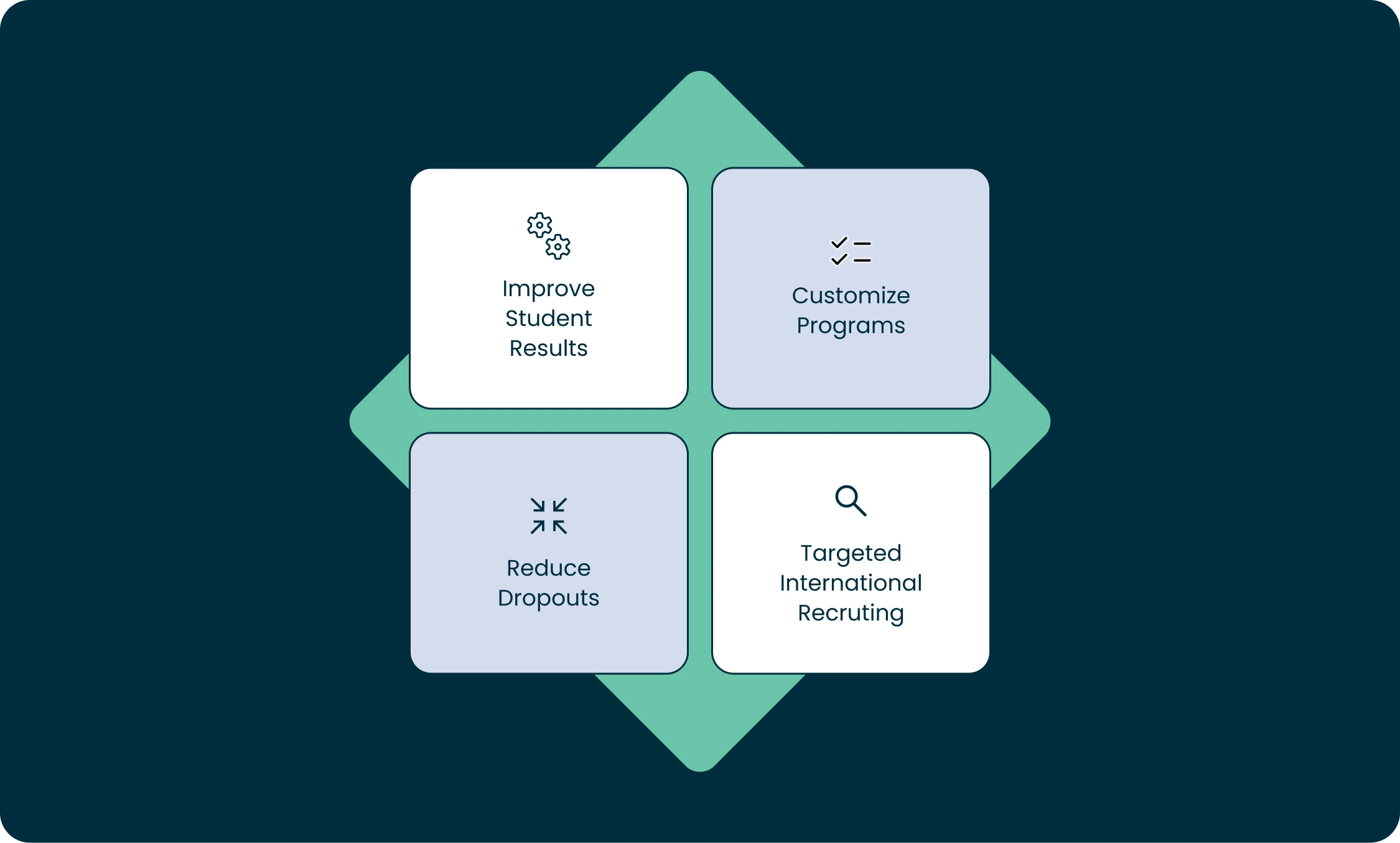
Thanks to research on big data, faculties are enabled to:
- Identify areas where students are successful or require additional support. Individually defined patterns make it simpler to understand particular needs and develop optimal personalized education strategies. This also helps students save time when choosing the right faculty.
- Track student activities, such as how long they take, what sources they use to prepare, what topics are ignored, and more. Big data in education can also be used to track students’ careers after graduation. It will also render them an invaluable service in choosing the right college and course of study.
- Create unique programs for each student. Even if there are hundreds of students in a college or university, different programs can be created for each of them using the so-called blended learning approach (simultaneous online and offline learning).
- Get predictions about future performance. It will also help to quickly analyze the course syllabus before it is introduced into the curriculum.
- Assess dropout rates. By identifying the top reasons why students leave the university, professors can develop programs and strategies to better retain students.
- Predict candidates more accurately, as well as analyze the factors influencing the application for training. Such knowledge will enable institutions to adjust resource allocation and recruitment strategies. This data flow will also help potential students analyze information about universities and colleges not only in their home country but around the world.
- Better understand the strengths and weaknesses of your students. A teacher gets the opportunity to analyze the heap of information as a whole and draw unambiguous conclusions. They recognize the problem and take action to prevent more complex issues. After a thorough analysis, the program is easier to adjust and get more personalized. Hence, it enhances student performance and achievement.
- Reduce dropout rates associated with a lack of understanding of the complexity of the students’ chosen specification. The analysis of information helps to assess the real abilities and talents of students and determine the best academic specification for them.
- Adjust current learning strategies. Educators may realize that a particular plan is not working well for a particular group of students. Timely adjustments can help them move forward and keep up.
- Increase performance. Thanks to the collection of information, educators constantly monitor trends. After a deep analysis, they can clearly understand the strengths and weaknesses of each student.
Big Data Is Rewriting the Rules of Education
In the coming years, big data could revolutionize learning. It is already possible to formulate a number of properties of the collected database, which makes it possible to increase the efficiency of its use in education:
Partial independence
Local data management can be employed for each database segment. At the same time, each segment is a component of the entire database but can be considered as a separate small database with its own set of procedures and rules.
Continuity and transparent access
All participants in the educational process get the opportunity to receive data from any segment of the database, even if they are already used for other tasks. If there are rights to access data, the analyst should not take into account the parameters of the physical location of the information. Data delivery is carried out automatically by built-in tools.
Data multiplication
The process of simplified data transfer from one database to another makes it easy to integrate different systems. Thanks to advanced technology, you can create complex structures with easy and reliable access.
Distributed requests
The collected data can be retrieved through distributed queries. Big data technology allows this to be done through parallel queries as opposed to multiple database shards.
Freedom of tech stack
Any software and hardware solutions can act as data processing tools. Big data helps to process the experience of thousands of teachers and students, and, based on the analysis of personalized experience, to obtain an effective methodology and select a learning mode.
The Oncoming Future: How Big Data Is Transforming Education
Big data in education is revolutionizing the way students learn, teachers teach, and institutions operate. Here’s what the future of education looks like:
-
Personalized Student Guidance
-
Students will receive detailed recommendations across various topics.
-
Programs can predict course completion success even before classes begin.
-
Learners will have the freedom to choose course paths and complete tailored assignments.
-
-
Early Support for At-Risk Students
-
Big data helps identify students who may struggle early on.
-
Teachers gain insights into specific knowledge gaps, enabling targeted interventions.
-
University groups will see fewer laggards as support becomes proactive.
-
-
Smart University and Career Planning
-
AI and robotics can suggest the best universities for prospective students.
-
Graduates will have digital portfolios to navigate the labor market efficiently.
-
Employers can use data-driven insights to select the right candidates.
-
-
Adaptive and Student-Centered Learning
-
Educational content becomes flexible and personalized.
-
Texts and learning materials are digitized and converted into numerical data for analysis.
-
Smart programs and curricula give students more control over how they navigate content.
-
-
Evolving Curricula
-
Courses may shift toward meta-subjects that combine multiple disciplines.
-
Curricula will adapt dynamically based on student performance and analytics.
-
-
Innovative Educational Analytics Methods
-
Predictive forecasting to anticipate learning outcomes from known data.
-
Network analysis, clustering, and structure determination to reveal learning patterns.
-
-
Enhanced Monitoring and Evaluation
-
Curriculum can be individualized for each student.
-
Teachers can optimize resource allocation and improve educational outcomes.
-
Big data in education is creating a smarter, more adaptive learning ecosystem, where students get personalized support, teachers can teach more effectively, and institutions operate with greater insight. The future of education is digital, data-driven, intelligent, and designed for success.
Conclusion
Big data in education opens up new horizons in modern learning. With its help, you can single out students for better or worse. You can monitor and resolve any situation. The analysis of data on the quality of education helps participants in the process to choose a career that best suits their interests and personal qualities.
If you want to contribute to the reform of education, you will need a lot of knowledge and skills. You may not be able to do it without a big data strategy and professional help. In order not to fail, contact us. Our specialists will help you create solutions powered by big data in education that will take your educational process or system to a new level.

Our Engineers
Can Help
Are you ready to discover all benefits of running a business in the digital era?
Our Engineers
Can Help
Are you ready to discover all benefits of running a business in the digital era?