
Feeding a world that’s heading toward 10 billion people by 2050 is a massive challenge, and no one feels that pressure more than farmers do. You’re expected to grow more food even though your land stays the same. Climate conditions are becoming harder to predict, and the soil is no longer as fertile as it once was.
On top of that, skilled workers are difficult to find, and the cost of running a farm keeps growing every year. Add strict regulations and lower profits, and the reality becomes clear: today’s farmers are asked to produce more with less.
So how do you deal with all these challenges? You can stick to traditional methods that get harder to maintain each season… or explore technologies like AI that can help you stay ahead.
Yes, many farmers already use GPS equipment or intelligent automation, but AI in agriculture goes much further. It can spot crop diseases early, show you where to use water and fertilizers more efficiently, and help you boost yields without expanding your land. In other words, artificial intelligence gives every farmer more clarity, confidence, and control in unpredictable conditions.
Let’s take a closer look at how AI in agriculture can support your business, and why the future belongs to those who choose to farm smarter, not harder.
Why Should You Use AI in Farming Today?
Not long ago, pairing the words “AI” and “agriculture” might have sounded like something surreal. Farming has fed civilizations for thousands of years, while artificial intelligence is still a newcomer for us.
But today, this unlikely duo is transforming the industry. AI in agriculture is a great way to tackle traditional challenges and make farming more profitable and efficient.
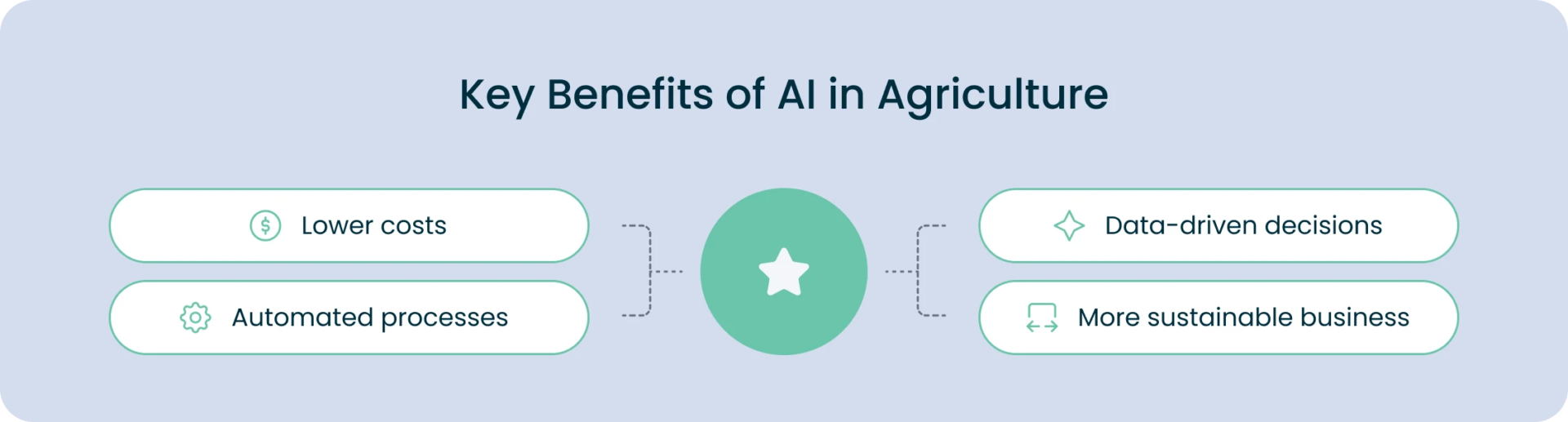
Lower costs
Every farmer expects higher yields with minimal expenses. If you want to make the most of your resources, AI tools can help. By combining soil management best practices and smart data analysis, artificial intelligence helps farmers grow more crops with less cost and effort.
With real-time crop monitoring, farmers can see which areas need irrigation, fertilization, or pest control. Methods like vertical farming also reduce resource use while increasing production. As a result, they enjoy better harvests, higher profits, and significant savings on water, fertilizers, and herbicides.
Automated processes
Farming isn’t an easy task, and labor shortages make every season even more challenging. AI in agriculture offers a solution to this problem. While mechanization once replaced heavy manual labor, digital automation is now taking farming to the next level.
Driverless tractors, smart irrigation systems, AI drones, automated sprayers, vertical farming software, and greenhouse robots are just a few examples. These tools work faster and more accurately than people. So, farmers can focus on bigger decisions while keeping productivity high.
Data-driven decisions
Imagine collecting and processing large amounts of information in seconds. AI models can track soil quality, weather patterns, crop growth, and the entire supply chain. With data analytics, you can forecast market demand, estimate crop prices, and pick the best time to sow and harvest.
AI in agriculture goes further. It monitors soil health, watches the weather, and shows where and when to use fertilizers or pesticides. Farm management software turns this information into easy steps. It helps you increase yields, save resources, and boost profits. AI solutions for agriculture also reduce uncertainty, making farming smarter and more reliable.
More sustainable business
AI helps farmers adopt regenerative agriculture practices such as reduced tilling, cover cropping, and smart nutrient management. It shows how these practices impact soil health and profitability, helping farmers make data-driven decisions and choose the best approach for their farm.
Artificial intelligence also identifies where fertilizer is needed, saving resources and reducing nitrous oxide emissions. Precision irrigation cuts water use as well. With AI, farmers can grow crops sustainably, lower costs, and protect the environment at the same time.
See, AI in agriculture is a practical solution that can bring a lot to the table. From improving yields and reducing costs to optimizing resources and supporting sustainable practices, AI has the power to transform the way farms operate. The key is understanding how to integrate artificial intelligence into your business.

Key Use Cases of AI in Farming
The global AI in agriculture market is growing fast. According to Grand View Research, it is expected to increase at a rate of 25.5% per year from 2024 to 2030.

Looks amazing, right? But what does it really mean? More and more farms and agribusinesses are turning to artificial intelligence. Let’s take a look at the most popular ways AI is being used in agriculture.
- Crop and soil monitoring: The wrong mix of nutrients in soil can bring harm to crops. AI helps farmers see what the soil needs and make the right adjustments to improve growth. It collects data on crop health, predicts yields, and spots problems early.
- Detecting disease and pests: AI can help spot diseases and pests in crops. Using computer vision, it scans images to find mold, rot, insects, or other threats. With alert systems, farmers can act fast to remove pests or isolate crops and stop diseases from spreading.
- Intelligent pesticide application: Spraying pesticides manually is slow, and automated systems aren’t always accurate. AI-powered drones fix this. They use computer vision to see exactly where and how much to spray, helping farmers protect crops while reducing waste and environmental harm.
- Automatic weeding and harvesting: AI can spot weeds almost the same way you would by noticing the differences in leaf shape, size, and color. Using computer vision, it can tell what’s a crop and what’s a weed, then let smart machines remove the unwanted plants.
- Automated irrigation: Imagine your crops getting exactly the water they need, right when they need it. That’s what AI does with IoT sensors. It monitors soil moisture and weather, then decides in real time how much water to give your plants. This saves water and supports sustainable farming.
- Smart greenhouses: Here, AI goes even further. It adjusts temperature, humidity, and light, helping your plants grow healthier and faster, all without extra effort from you.
- Detecting leaks in irrigation systems: AI can help find leaks or problems in irrigation systems. It analyzes data to spot unusual patterns, like changes in water flow or pressure. This helps farmers catch leaks early, saving water and protecting crops.
- Yield mapping: It uses AI to analyze field data in real time, helping farmers understand how their crops are performing. With 3D mapping, sensors, and drones, farmers can predict soil yields and plan more accurately. So, farmers know where to plant, when to sow, and how to use their resources for the best results.
- Monitoring livestock health: Spotting health problems in animals isn’t always easy. AI tools can help by watching cattle from a distance and noticing when something looks wrong. They can detect unusual behavior and even track things like birthing. This helps farmers act sooner, keep animals healthier, and boost milk production.
These key applications of AI in agriculture show just how quickly artificial intelligence is spreading across the farming world. You can use it for almost anything, from improving harvesting to supporting more sustainable farming. Hopefully, you’ll find something on this list that fits your needs and helps you rethink the way you approach your agribusiness.
What Challenges You May Face with AI in Agriculture and How to Fix Them
AI in farming can bring real value to your business. But before you dive in, it’s important to understand the challenges you may face on the way to AI adoption and how to handle them.
Resistance to new technology
Trying something new always feels risky. Many farmers prefer the traditional methods they’ve trusted for years. And without clear guidance or proper training, it’s hard to trust unfamiliar tools, even when they can bring real benefits.
What we recommend: Begin with simple digital tools that are easy to use, then gradually move to more advanced AI features. Work with a tech partner who explains things clearly, trains your team, and supports you through the whole process.
High upfront costs
AI in farming can save money over time, but the first investment is often expensive. For small farms, this can be a real barrier. The price of hardware, sensors, and software can stop many farmers from even considering AI.
What we recommend: Start with tools that match your budget and bring the fastest return, like basic monitoring systems or simple automation. Look for government grants, subsidies, or private funding programs that support digital farming.
Limited hands-on experience
Not every region has access to modern farming tools. In areas where advanced tech is still rare, farmers need training, guidance, and ongoing support to feel confident using AI in agriculture.
What we recommend: Choose tech providers who do more than just sell tools. Look for partners that guide you through setup, provide step-by-step training, and offer ongoing support to help you get the most from your AI solutions.
Technology limitations
AI still relies on high-quality data, which isn’t always easy to get. Robots and sensors can struggle in harsh or changing farm conditions. That’s why human supervision is important, especially at the beginning.
What we recommend: Start by combining AI tools with hands-on monitoring. Review the data regularly and guide the AI when needed. Over time, as you collect more accurate data and the technology learns, AI can handle tasks more effectively.
You can see that implementing AI in farming comes with great benefits, but also challenges that can slow you down. With our recommendations, you’ll navigate this path much more smoothly.
Need a skilled tech team to help with AI integration? Contact Forbytes to get a strategy tailored to your farm or agribusiness.
The Next Era of Farming with AI in Agriculture
The future of AI in agriculture looks promising, especially for sustainability and efficiency. Its impact is set to transform how we grow, monitor, and manage crops.
First, smart farming tools and intelligent automation will handle repetitive, time-consuming tasks. This allows farmers to focus on strategic decisions and operations that require human involvement.
Second, advancements in computer vision and agricultural robotics are making AI solutions more affordable and accessible. Farms of all sizes will be able to adopt cutting-edge technology to boost productivity.
Third, AI can better tackle challenges like climate change, environmental pressures, and rising global food demand. These technologies provide data-driven insights to make farming more resilient and sustainable.
Fourth, real-time monitoring powered by AI will improve crop health and product quality. Farmers can detect issues early, optimize resource use, and ensure higher yields.
Finally, the role of farmers will evolve from manual labor to managing and overseeing intelligent agricultural systems. Knowledge of IT solutions, data analytics, and agribusiness intelligence will become a must for modern farming.
How Forbytes Helps Bring AI to Agriculture
All in all, bringing AI into the agri company is worth the effort. With the right AI tools in place, crops grow healthier, operations run smoother, resources are used more efficiently, and decisions become smarter. The key is to have a clear, step-by-step plan and stick to it.
If you want to stay ahead in modern farming, now’s the time to build your AI strategy and start integrating the tools that fit your fields and operations.
Need help with AI consulting or integration? At Forbytes, we’ll find the right AI solutions for your farm and equip your systems with smart technology to make everything faster, sharper, and more productive.
Let’s talk. Reach out, and we’ll discuss the next steps to bring AI to your business.