

Modern commerce is not a linear movement. Before buying from your marketplace, customers use multiple channels and interaction points, including social media, e-commerce platforms, mobile applications, ads, and more. According to Capital One Shopping Research, 91% of consumers engage with e-commerce businesses this way, proving the rising demand for omnichannel experiences in retail.
Similarly, clients expect an integrated experience after purchasing. They require your marketplace to show them logistics info, payment status, inventory updates, etc., all in one system. With marketplace integrations, you can turn your e-commerce platform into a convenient, all-in-one stop for the client, driving higher customer satisfaction and boosting sales.
In this article, we will discuss the importance of marketplace integration, guide you through the main types and examples, and explain how to link two or more systems in a consistent and stress-free way.
Key Takeaways
- Customers gain full visibility of orders, inventory, and payments, making the buying process seamless and transparent.
- Merchants benefit from centralized dashboards that simplify inventory management, sales tracking, marketing, and customer support across multiple sales channels.
- Automation reduces manual work, prevents inventory discrepancies, and enables your marketplace to scale efficiently.

Marketplace Integration Explained: Why It’s Not Only About Connecting Software
Marketplace integration means adding third-party software to your main marketplace platform. However, this process is not only about the technical side. By connecting various systems, you can solve real operational challenges and expand buyer and seller audiences.
Data sync plays a vital role in any marketplace integration. Instead of switching between systems manually, users get access to all product data in one place, which increases their business capabilities and boosts customer retention.
In what way? Customers receive 100% visibility of order details and get enough flexibility for decision-making. They don’t have to reach out to the support team to clarify the order status or go to the logistics company’s site for order tracking. Instead, a user just logs into the personal cabinet and feels as if they are in a physical store where purchases are made end-to-end.
As for your merchant audience, they get more operational instruments thanks to marketplace integrations. Through the connected channels, your merchant partners access consolidated performance and inventory data, manage customer inquiries, centralize their marketing efforts, analyze e-commerce metrics, and more.
Using a single dashboard, they get a 360-degree view of their online shop. As a result, they spend less manual effort on collecting data and have more time for using this data practically.
So, why do marketplace integrations matter? By connecting your marketplace to different systems, you allow customers to actually “own” the purchase process. Meanwhile, your merchants also benefit from automation and operational efficiency that come with marketplace integrations.
Altogether, by benefiting these audiences, you grow the popularity of your marketplace and increase profits accordingly.
Why Do Marketplaces Need Integrations? Key Benefits to Explore
Not all marketplace integrations are equal. The choice of the solution depends on your needs and the expected project results. In this section, we explain why major marketplaces invest so much of their budget into connecting their software to third-party solutions. The key integration benefits include:
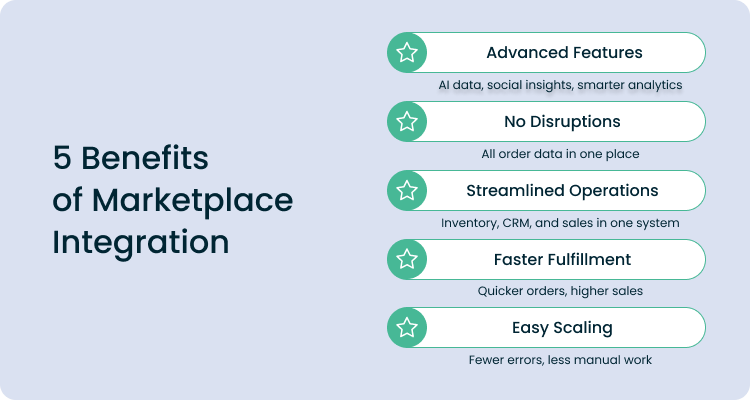
- New features and functionalities for marketplace users. Marketplace integration opens the door to the opportunities that other systems offer. For example, by connecting your marketplace to AI-powered software, you get the chance to increase conversion rates by up to 15%.
- No disruption to marketplace operations. Merchants and customers no longer need to switch systems to get a complete picture of each order. All the data is displayed in one place. This saves time, effort, and around 20% of the operational budget.
- Streamlined processes and business connectivity. Marketplace integrations centralize all retail operations under one roof. Merchants can manage their inventory sales, CRM, and analytics using a single system. And as a result of integrated analytics, 72 % of organizations highlight improved decision‑making capabilities and, thereby, wider market opportunities.
- Faster order fulfillment and higher sales. As numbers show, AI‑optimized logistics can cut delivery times by 25% and boost repeat purchases by 15%. The faster your merchant completes the order, the more they earn. The convenience you give your merchants affects the popularity of your marketplace and your profits accordingly.
- Error prevention and scaling without complexity. Without a powerful marketplace integration, e-commerce teams have to manually fill in data. With integrations, you reduce manual data entry, allowing merchants to do more with less and cut errors. For example, by connecting your marketplace to automated warehouse systems, you can increase the fulfillment accuracy by up to 70%.
Want to implement the right integration and test all these benefits in practice? Contact us, and let our experts analyze your needs, choose the solution, and connect it efficiently.
Must-Have Integrations for Online Marketplaces: Types & Examples
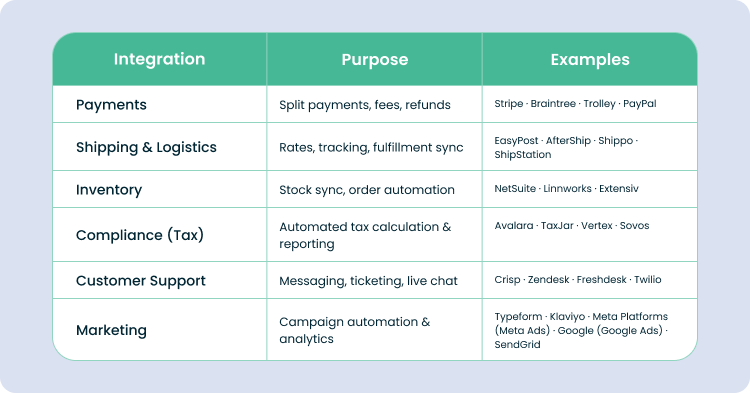
Now that you know how important it is to add new functionality to your marketplace, we present you with the top 6 must-have integrations. The final choice of solutions depends on your goals, marketplace model, technical requirements, and system compatibility. Consider these critical categories to make your marketplace powerful:
Payment marketplace integrations
Payment integration designed for marketplaces should offer multi-vendor payment features.
Unlike simple e-commerce payments, marketplace payment solutions should also automatically deduct fees, support refunds, ensure financial compliance, and allow for split payments.
Popular payment apps for marketplaces: Stripe, Braintree, Trolley, PayPal.
Shipping and logistics integrations
Since online shoppers expect real-time access to data and fast, reliable delivery, you will need to connect your marketplace platform with a shipping management system.
Shipping marketplace integrations are used to display real-time shipping rates at checkout, track order shipments without leaving the platform, and automate order processing for all parties involved.
Popular shipping & logistics apps for marketplaces: EasyPost, AfterShip, Shippo, ShipStation.
Inventory management integrations
Multi-vendor and multi-location marketplaces make it harder to manage inventory levels. Sellers require real-time inventory data to prevent overselling. Marketplace teams may use the same data to coordinate stock levels across vendors, which is impossible to do without integrations.
By connecting your marketplace to inventory management software, you will keep your inventory data in sync, cut manual work, and prevent inventory management errors.
Popular inventory management apps for marketplaces: NetSuite, Linnworks, Extensiv.
Compliance integrations
Compliance marketplace integration acts as the “legal shield” for your platform. They automate the massive headache of staying on the right side of the law.
Without seamless integration of such tools, your team would be buried in manual ID checks and complex tax spreadsheets. By automating compliance processes, you ensure your platform stays protected from fraud and hefty government fines.
Popular compliance management apps for marketplaces: Avalara, TaxJar, Vertex, Sovos.
Customer support integrations
Customer support integrations turn your marketplace into a professional, unified service hub. In a multi-vendor environment, support is notoriously tricky. You have to bridge the gap between the buyer, the seller, and your own platform’s support team.
Instead of jumping between dozens of seller portals or email threads, these marketplace integrations pull every conversation into a single dashboard. Crucially, they link each ticket to real-time order data, allowing agents to see exactly what was bought, when it was shipped, and who the vendor is, without asking the customer for a single order number.
Popular customer support solutions for marketplaces: Crisp, Zendesk, Freshdesk, Twilio.
Marketing integrations
Marketing integrations are the “growth engine” of your marketplace. While your merchant partners sell products on your platform, these tools ensure that the right customers actually find them.
By enabling this marketing integration, you can use real-time data (like what a user browsed or what they left in their cart) to trigger personalized emails, SMS alerts, or social media ads. This automation keeps your marketplace “top of mind” for merchant partners without requiring a huge manual marketing team.
Popular marketing integrations for marketplaces: Typeform, Klaviyo, Meta Ads, Google Ads, SendGrid.
6 Steps to Start with Marketplace Integrations in a Stress-Free Way
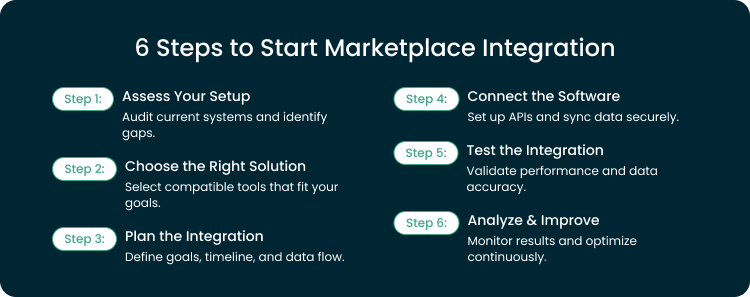
Below, we suggest a 6-step checklist to plan your integration process efficiently. If you get stuck at any of these steps, contact Forbytes. Whether you are at the beginning of your integration journey or need post-integration support, we will gladly help.
1. Assess your current setup
Start your marketplace integration process by analyzing your current infrastructure. What tools have you already set up, and which ones do you lack? Do you have an ERP system, payment gateway, CRM system, and CMS software connected to your marketplace? What solutions do you still need for a more consistent merchant experience and higher customer trust?
For the preferred tools, analyze the technical limitations and potential data exchange logic to make the audit practical and realistic. By documenting essential data, you will be ready for the potential challenges and quickly solve them.
2. Pick the best solution to add
Find the best solution for your marketplace integration. Look at what the competitors offer on their marketplaces. Check the solution for compatibility and performance. Figure out what type of connection this software allows for.
Study the features offered in the solution. How much automation is here? Is AI implemented under the hood? The chosen tool should perfectly align with your expectations, including the implementation cost, business impact, and long-term value.
3. Plan out the marketplace integration
Planning out the system integration involves defining goals and KPIs, breaking the project down into milestones, and defining timelines and responsible teams.
After the general plan is ready, you need to dive into the technical side of the project. The technical team will map the data flow between the two solutions, prepare the data formatting logic and rules, and ensure that the strategy is well-supported by both systems.
4. Connect the software
After planning, move to the step-by-step implementation. Your technical team will be responsible for setting up e-commerce API credentials, authorizing marketplace accounts, and ensuring secure data sync.
When your marketplace integrations are structured, it reduces errors and the risks of data inconsistencies.
5. Perform testing
Test your software integration before going live. Import test data and make sure it is displayed correctly. Both automated and manual testing are required for proper integration performance.
An important part of the testing is simulating merchant and customer behavior on your marketplace. For this, you can involve real website users or entrust the process to your QA team.
6. Analyze and improve the integration
That’s the moment when your marketplace integration goes live. The work does not stop there. Likely, your integration will require some refinement. To figure out how the connection performs, allow for user feedback.
By studying reviews and performing regular system audits, you will make sure that the integration brings long-term value to your business.
Make Your Marketplace More Effective with Forbytes
As you can see, modern commerce requires businesses to consolidate their effort, data, and tools into a unified IT infrastructure. As each system operates under its unique rules, without integration, it’s hard to get a consistent view of a business.
In this article, we covered everything you need to know about marketplace integration to prepare your team for the positive changes. The next step is implementing these changes technically.
If you are looking for experts in e-commerce system integrations, you are in the right place. Forbytes has 15+ years of experience in software engineering. Retail & e-commerce are at the heart of what we have been doing during that time.
With numerous clients in this industry, we’ve dealt with nearly every challenge that retailers typically face and have an efficient, budget-friendly, and intuitive solution for your goals. Reach out to us to get a free consultation on your integration needs.