
78% of organizations say they struggle to keep up with today’s pace of change, and that concern is reasonable. Without emerging technologies like AI integration, cloud-native solutions, and business intelligence and analytics, staying competitive is becoming increasingly difficult.
What’s truly impossible is driving innovation when a company still depends on legacy systems. In 2026, legacy application modernization is not just a technical upgrade. It’s a critical business investment that helps companies strengthen security, improve user experience, and stay flexible every day.
Forbytes is here to explain why 2026 will be a defining year for business application modernization and which trends companies should watch to stay ahead.
Why Application Modernization Becomes a Business Priority in 2026
If you still think that app modernization is something “extra” and you can postpone it, the facts below may change your mind.
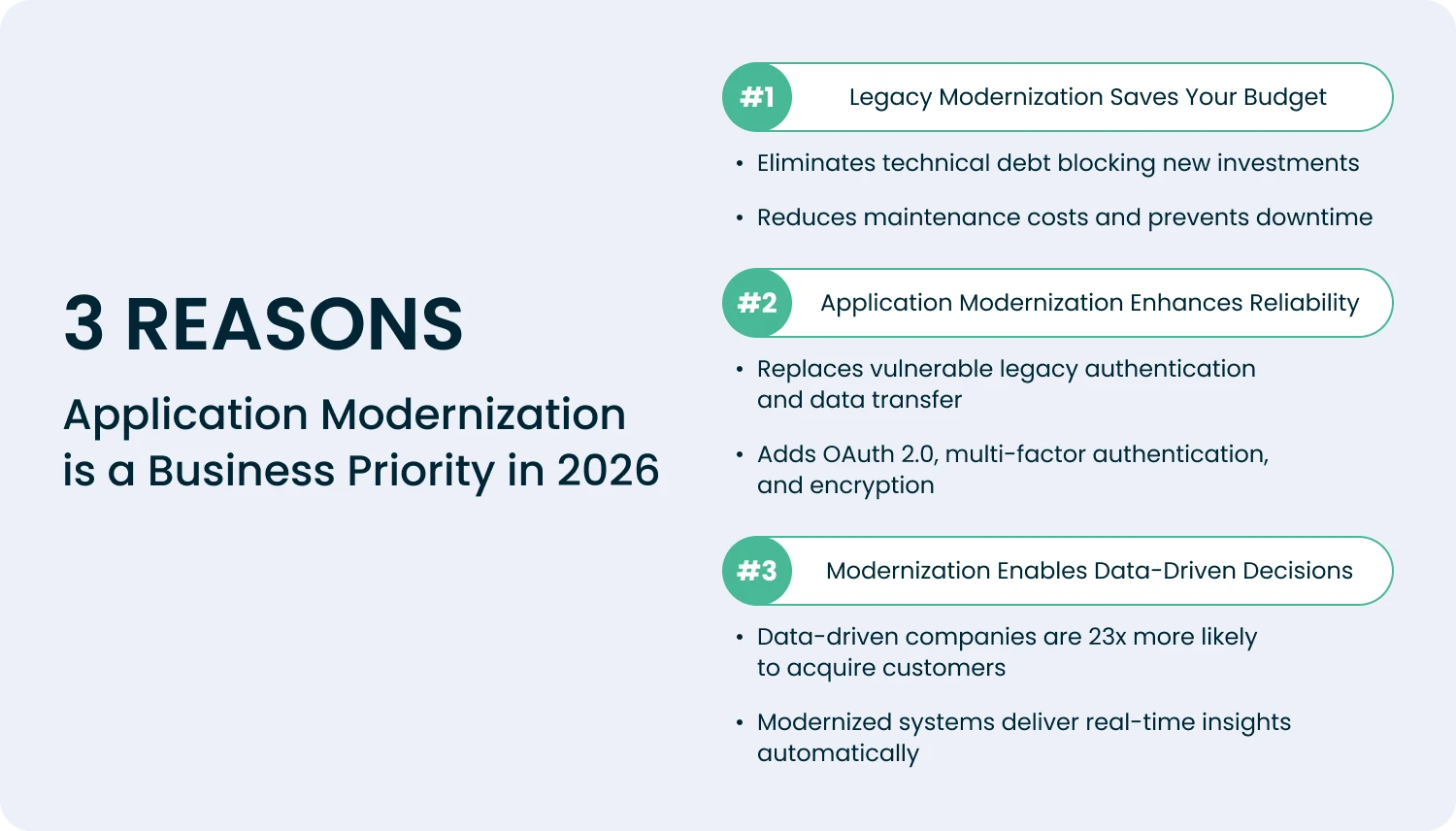
1. Legacy modernization saves your budget
Every day you put off application modernization, you’re not saving money; you’re spending it twice. Once to keep the legacy system operational, and again to deal with all the problems it causes.
Technical debt costs
56% of organizations say fixing technical debt consumes so much budget that they can’t invest in new technology programs. The money meant for growth simply gets redirected to keeping old systems running.
Infrastructure management costs
When you rely on outdated systems, you invest money in maintaining those systems, including expensive licensing fees and hard-to-find specialists who know how to deal with old tech.
Modern applications run on widely used modern platforms or technologies, and developers actually want to work with up-to-date tech. As a result, organizations that once used application modernization services save $19.1 million over three years on application development-related infrastructure costs alone.
Downtime costs
Legacy systems’ architecture increases the possibility of another costly problem — downtime. Outdated systems typically run as single, monolithic applications on dedicated servers. If one component fails, the entire system goes down. The cost of the downtime? Averages $100,000 per hour for businesses.

2. Application modernization enhances reliability
Legacy applications have vulnerabilities in authentication systems, unencrypted data transfers, and outdated protocols that hackers know how to exploit. Every day you keep these systems running, you’re accepting risks that your competitors may be avoiding.
Successful modernization initiatives support:
- Current security protocols like OAuth 2.0 for secure access management;
- Multi-factor and biometric authentication to prevent unauthorized access even when credentials are compromised;
- Built-in data encryption during storage and transmission to make sure no one can actually read your data if it’s intercepted.
3. Modernization process makes data-driven decisions possible
Data-driven decision making is a must for companies that want to have a competitive advantage, and the numbers back it up. According to McKinsey, data-driven companies are 23 times more likely to outperform their competitors in customer acquisition, 19 times more likely to stay profitable, and 7 times more likely to retain customers.
But data-driven decisions require modernized infrastructure. Without it, your systems can’t connect automatically, and insights don’t reach your team in real time. Instead, employees exchange data manually. They need to copy information from one system to another, wasting time and resources on work that should happen automatically.
Key Application Modernization Trends Driving Business Growth in 2026
Forbytes has been modernizing applications for over a decade. Here’s what we’re seeing shape up as the major application modernization trends for 2026.
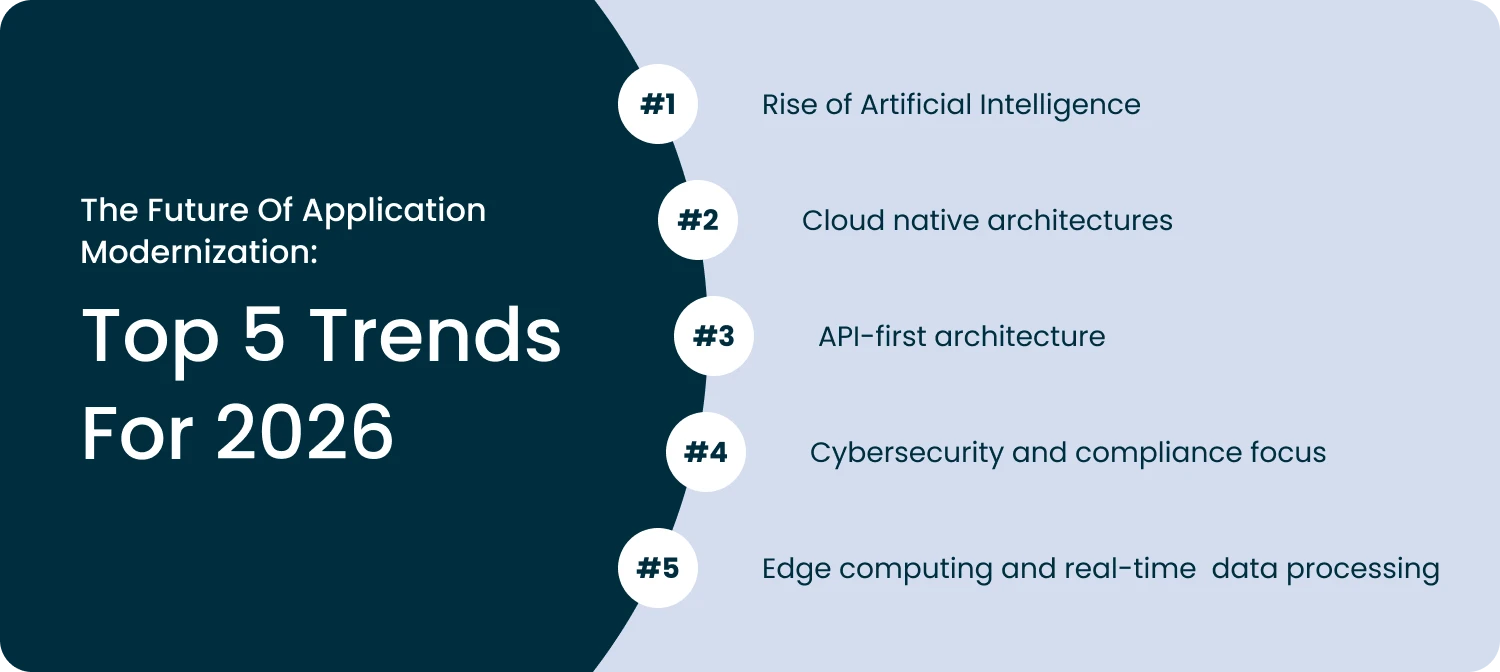
Rise of Artificial Intelligence
AI implementation continues to be the trend, with 91% of tech companies worldwide prioritizing investment in generative AI development for better analytics and automation of routine tasks.
AI is now also capable of improving legacy system modernization processes and reducing the risk of disruption during the production process. AI-powered tools analyze old code bases to identify dependencies, map data flows, and suggest refactoring strategies.
Cloud native architectures
AI tools depend on cloud native architecture to scale. Cloud apps use orchestration tools to automatically manage containers (lightweight packages that include everything the application needs to run) across servers. Instead of one large application running on a single server, cloud native applications break into smaller components that can scale independently.
Thus, 95% of companies are investing in cloud transformation, and most organizations do not view AI and cloud integrations as separate parts of application modernization.
Let’s discuss how to adopt these technologies without disrupting your business. Reach out to Forbytes.
API-first architecture
Businesses need to move faster than monolithic legacy applications allow. When your checkout process, inventory management, and customer data all live in one tightly coupled system, even one small improvement, like changing the checkout flow, means testing and redeploying everything.
API-first design stands for building the application’s communication layer before building the application itself. Every function exposes a clean interface that other systems can use.
Microservices take this further: instead of one monolithic legacy application handling everything, each business function becomes its own independent service.
Cybersecurity and compliance focus
Modern architecture operates on robust security measures, such as zero-trust principles. Every access request gets verified: authenticate the user, check their device health, confirm they have permission for this specific resource, and log the access.
Legacy applications often rely on perimeter security: once you’re past the firewall, you can access internal systems freely. Outdated systems lack the granular access controls, don’t log detailed audit trails, and store sensitive information unencrypted or use outdated encryption standards.
Compliance requirements are also getting more complex and start to affect database design, backup strategies, and how you route requests. For instance, data residency regulations like GDPR restrict where data can be stored and processed.
Edge computing and real-time data processing
Transferring data from a device to a cloud server and back takes time. For many areas, such as production lines or logistics networks, the shortest delay is unacceptable. Edge computing solves this problem by processing data on local devices or nearby servers.
Edge computing also reduces bandwidth costs and network congestion. A single manufacturing facility with IoT may have thousands of sensors collecting metrics every second. Streaming gigabytes of raw sensor data is costly and may overload the network bandwidth. So, instead of it, an edge device sends aggregated statistics or alerts only when values exceed thresholds.
App Modernization Case Study: How Forbytes Prepared Guesty’s Platform for AI-First Development
But how does business application modernization look in real life, and what should business users prepare for? Forbytes is sharing the legacy modernization for Guesty case study. Here, we prove that with a dedicated development team, app modernization happens gradually and delivers improvements at every step.
Client’s modernization challenge
Guesty faced a problem that almost every growing business faces. They shipped features fast on a technical foundation built years ago in an outdated version of Node.js, stored in a single repository without TypeScript.
While this approach worked when the project was small, over time, the repository grew tangled and confusing. Engineers couldn’t see how the different parts connected. The team was not able to make changes because they couldn’t predict which part of the legacy application might break.
Engineers couldn’t use AI-powered tools for debugging or repetitive coding tasks either. When AI assistants tried to analyze such a large, unstructured codebase, they simply hallucinated.
Forbytes’ application modernization approach
Forbytes started by mapping what actually existed. Working with Guesty’s teams, we identified which parts of the legacy system caused the most problems and which domains needed digital transformation first.
We chose a gradual decomposition modernization strategy: move code from the monolithic repository into independent microservices, one domain at a time.
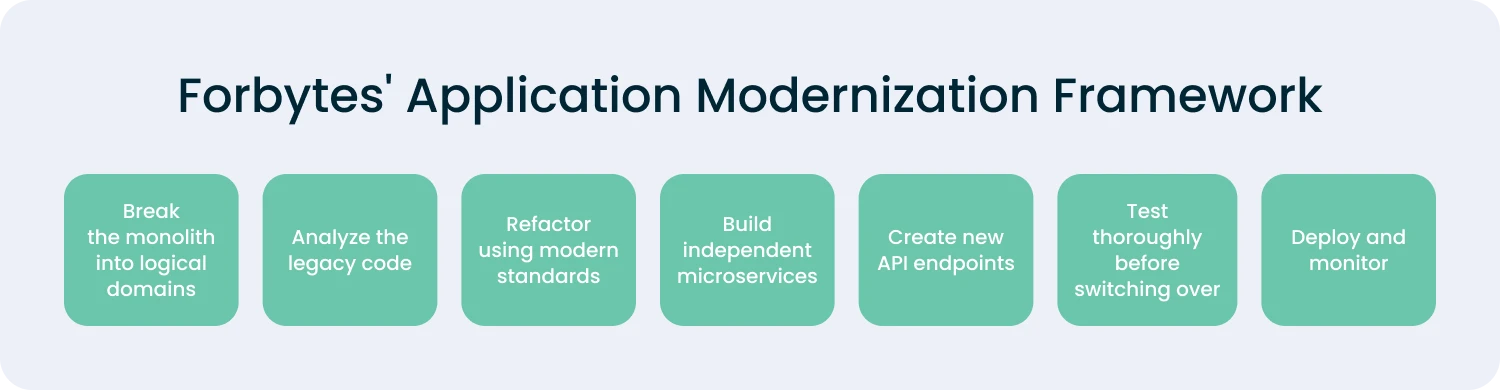
For each component, Forbytes followed a precisely built application modernization lifecycle:
- Break the monolith into logical domains. We separated the repository by business function, so rebuilding Guesty’s billing system was possible without touching the reservations or user management parts.
- Analyze the legacy code. Old code rarely comes with documentation that explains what it actually does, so we map out the logic, identify dependencies, and understand how data flows through the system.
- Refactor using modern standards. Forbytes’ engineers rewrote legacy codebases in TypeScript, restructured files into clearer patterns, and removed duplicate logic.
- Build independent microservices. Each service handled one domain with its own database, its own deployment pipeline, and its own scaling behavior.
- Create new API endpoints. Our team built new APIs for each service, separating business logic from infrastructure concerns, making the code testable.
- Test thoroughly before switching over. We ran comprehensive tests using Postman and automated testing frameworks to verify that the new service behaved exactly like the old logic. No traffic moved to the new service until we confirmed it worked correctly under production-like conditions.
- Deploy and monitor. After testing, we released the new service to production, monitored its performance, error rates, and system behavior to catch any issues immediately.
Then we repeated the process for the next domain.
Guesty’s platform now runs on a distributed architecture where each service can be developed, tested, and deployed independently. The structured codebase works effectively with AI assistants, and the modular architecture makes it straightforward to integrate new AI capabilities as Guesty builds them into their product.
Final Thoughts
Application modernization isn’t optional if you want your business to keep up. This one process can save you budget, keep your data protected, and ensure you can use any innovation you need.
AI-driven automation and cloud, edge computing, API-first architectures, and a focus on cybersecurity are among the top application modernization trends to watch and follow this year. But the key is having a trusted partner who can guide you through and make the application modernization process as smooth and impactful as it was for Guesty.
Ready to start your legacy system modernization process? Let’s talk.