





Online shoppers now reach products through AI assistants, social media feeds, and retail media ads, alongside the search bar. Holiday traffic to US retail sites from generative AI tools grew 693% year over year in 2025, according to Adobe. At the same time, shoppers compare prices harder and retailers absorb higher costs.
These shifts change what type of investment you should consider next. Some eCommerce trends need a platform decision. Others need cleaner product data or a new payment method at checkout.
Below, the Forbytes team covers the eCommerce trends for 2027, what changed since last year, and how to decide which ones deserve a place on your roadmap.
Three Market Shifts to Plan Around in 2027
Understanding the market conditions behind emerging trends helps you decide which investments to make now and which can wait. Three shifts stand out.
First, shoppers look for value by default. Deloitte’s 2026 Retail Industry Global Outlook reports that four in 10 Americans now shop in deal-driven or cost-conscious ways. Nearly 7 in 10 retail executives see this value-seeking as a structural change that will outlast inflation.
Second, costs keep rising. In the same Deloitte survey, 95% of executives expect trade policy changes to raise their costs, and 73% plan to adjust prices upward over time. A KPMG survey of 300 US C-suite leaders, published in March 2026, found that 55% plan price increases of up to 15% within six months.
Third, product discovery moves beyond the search bar. Shoppers now find products through AI assistants, social commerce channels, and retail media placements, and online sales follow them into these channels. Online retailers who make their catalog visible there reach shoppers earlier in the decision.
Here is how online retail teams can respond:
- Expand into new channels, including eCommerce marketplaces, social platforms, and AI assistants, to reach shoppers where they already search.
- Use customer data and analytics to sharpen personalization and lift marketing ROI.
- Build a platform that adapts to new channels and tools without a full rebuild each time.
The eCommerce industry trends below show where these responses turn into concrete technology decisions.
11 Latest Trends in eCommerce for 2027
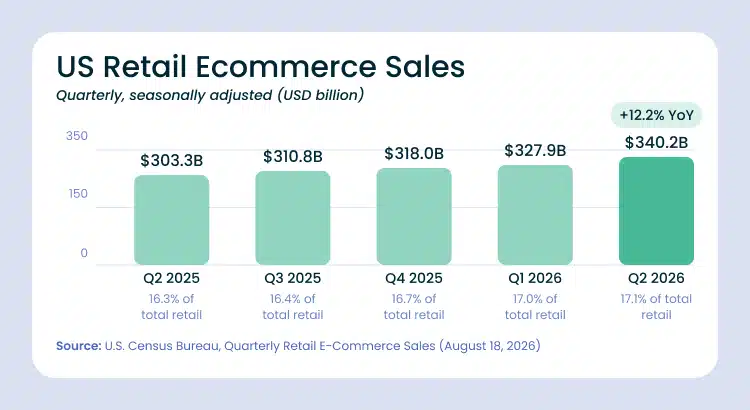
Another fact is that the eСommerce market keeps growing, which gives you room to invest. US retail eСommerce sales reached $340.2 billion in the second quarter of 2026, up 12.2% year over year, according to the US Census Bureau. Online sales now account for 17.1% of total US retail sales.
You can use the trends below to check which ones match your customers, your current platform, and your team’s capacity.
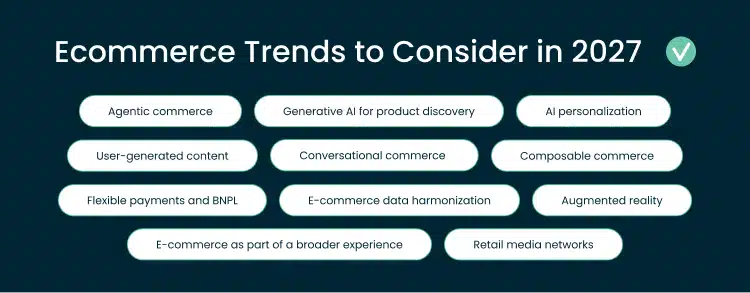
Agentic commerce: AI agents that shop for customers
Agentic commerce is the newest on this list. AI agents now search, compare, and complete purchases on the shopper’s behalf. The shopper states a goal, such as “find running shoes under $120 that ship by Friday,” and the agent handles the rest.
The numbers show early scale. During Cyber Week 2025, AI and agents influenced $67 billion in global online sales, or 20% of all orders, according to Salesforce. McKinsey projects that by 2030 agentic commerce could orchestrate up to $1 trillion in US B2C retail revenue and $3 trillion to $5 trillion globally.
Agentic commerce already has the backing of the largest names in retail and payments. In January 2026, Google launched the Universal Commerce Protocol, co-developed with Shopify, Etsy, Wayfair, Target, and Walmart. Visa, Mastercard, Stripe, and Adyen are among more than 20 partners that endorsed it. OpenAI introduced the Agentic Commerce Protocol, which lets merchants sell to shoppers inside ChatGPT.
Generative AI for product discovery
Generative AI changes how shoppers find products before they reach eCommerce sites. The traffic growth from AI tools came with stronger engagement. During the 2025 holiday season, AI-referred visitors to US retail sites converted 31% more than visitors from non-AI sources, according to Adobe Digital Insights. Time per AI-referred visit was 45% longer than visits from other channels.
AI personalization for a tailored shopping experience
Artificial intelligence already runs product recommendations, search, and 24/7 support in many eCommerce stores. The eCommerce technology trends for 2027 push AI in eCommerce further into real-time personalization across every touchpoint.
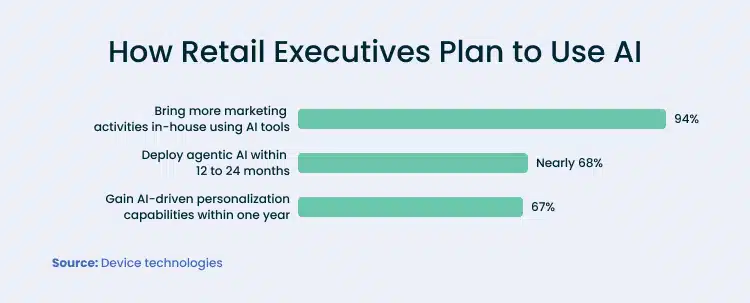
In Deloitte’s 2026 survey, 67% of retail executives expect to have AI-driven personalization capabilities within one year, and 94% plan to bring more marketing work in-house with AI tools. Generative AI now writes product descriptions, builds landing pages for segments, and adapts offers to browsing behavior.
Conversational commerce for a closer connection with customers
Conversational commerce lets shoppers buy through a dialogue. Chat apps, chatbots, voice assistants, and messaging platforms all deliver it. Marketers also call it conversational marketing or chat commerce.
Generative AI has made these conversations far more capable. Assistants now answer detailed product questions, compare options, and complete orders inside the chat. This brings the guidance of a store associate into the web and mobile shopping experience.
eCommerce data harmonization for AI readiness
Data harmonization brings different types of data into one consistent dataset. Teams get access to high-quality data in agreed formats, spend less time searching for information, and cut costs.
This eCommerce market trend now carries more weight because every AI initiative above depends on it. Agents, recommendation engines, and AI search tools read your product, customer, and order data. When that data lives in one structured model, your AI tools return accurate answers and your analytics show which areas to optimize.
UGC for an engaging customer experience
User-generated content (UGC) covers any content a customer creates about a brand: social media posts, videos, images, and written reviews. It gives other shoppers social proof and helps them decide faster.
UGC now has a second audience: AI models. Bazaarvoice’s 2025 Shopper Experience Index, a survey of over 7,000 consumers in six countries, notes that AI systems analyze customer reviews to shape their recommendations. Almost 1 in 4 respondents has used a generative AI tool to search for a product. Review volume and ratings affect how often AI assistants surface your products. Make it easy for customers to leave reviews, and publish them in a format search engines and AI tools can read.
Is Your Online Store Ready For Modern Customers?
Create fast, intuitive, and conversion-driven shopping experiences across devices.

Flexible payment methods and buy now, pay later
Shoppers expect to pay with the payment method they prefer, completed in one click. A credit card, digital wallet, or buy now, pay later option at checkout serves different preferences and turns first-time buyers into regular ones.
Digital payments now dominate online. Digital wallets accounted for 56% of global online spending in 2025, according to the Worldpay Global Payments Report 2026. Pay later options keep growing too: US shoppers spent over $20 billion with buy now, pay later during the 2025 holiday season, up 9.8% year over year, and made 82.2% of those purchases on smartphones, according to Adobe.
Composable commerce for faster change
Composable commerce builds the commerce platform from modular, interchangeable components connected through APIs. Businesses replace or add one component at a time and scale each part independently.
Composable commerce also prepares the platform for AI. The MACH Alliance’s 2026 research, based on a survey of 600 enterprise technology decision-makers, found that 78% of organizations with fully implemented composable foundation technology report clear ROI on AI investments. Among organizations in early planning stages, the figure is 13%.
Augmented reality (AR) for product visualization
Augmented reality brings hands-on experience into online shopping. A shopper can place a sofa in the living room, try on glasses, or look inside a car from a laptop or phone.
Among the digital commerce trends on this list, AR speaks most directly to returns. It lets customers check fit, size, and color before they buy, and many tools let them change materials and colors in real time.
AR delivers the most value in categories where fit or scale drives returns, such as furniture, eyewear, and apparel. Start with your highest-return categories and compare return rates before and after launch.
Retail media networks as a new revenue stream
Every retailer with steady traffic already owns something brands want: shoppers who are about to buy. Global retail media turns that audience into a new revenue stream. Retailers sell sponsored placements on their websites, apps, and marketplaces to the brands they stock, and use first-party data to show each ad to the right shopper.
Brands are spending heavily on it. US commerce media ad revenue reached $63.4 billion in 2025, up 18% year over year, according to the IAB/PwC Internet Advertising Revenue Report.
eCommerce as part of a broader experience
eCommerce continues to grow across industries. Companies add product sales and marketplaces to their core services to open new revenue streams. A beauty salon sells hair products on the same site where clients book appointments. An online education platform sells books and learning materials next to its courses.
At Forbytes, we have an on-point story that shows how a business outside retail can use eCommerce to grow. Our client, Sharkmob, a top-tier game development company, designed a full-scale in-game store where players buy items to customize their characters and improve their capabilities.
Sharkmob needed a store management system integrated with the in-game store and the game as a whole. Our software engineers built it. With the custom system Forbytes developed, Sharkmob managers track in-game purchases, organize game season sales, manage store assortment, view analytics, and more.
Sharkmob added a store to the game experience and gained a custom management system that runs eCommerce operations under the hood. Contact us if you plan to add eCommerce offerings to your service line. Our team builds eCommerce systems for every stage of the supply chain, from back-office managers to customers using the storefront.
How to Prioritize: 5 Trends in eCommerce to Act On First
Eleven trends is a long list, and few budgets stretch that far in one year. The practical question is where to start. If you choose 5 eCommerce trends for 2027, we’d take them in this order, because each one makes the next easier and cheaper to build.
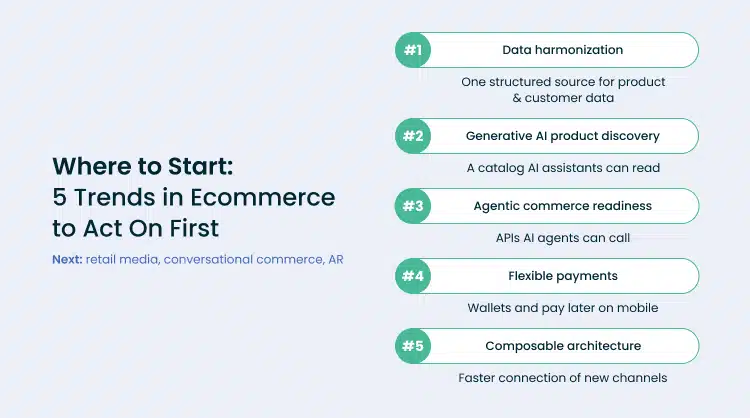
- Data harmonization: clean, structured product and customer data supports every AI initiative that follows.
- Generative AI product discovery: make your catalog readable for AI assistants that now send high-converting traffic.
- Agentic commerce readiness: expose catalog, inventory, and checkout through APIs that AI agents can use.
- Flexible payments: add the wallets and pay later options your shoppers already use on their mobile devices.
- Composable architecture: separate the components you change most often so you can connect new channels faster.
Retail media, conversational commerce, and AR fit on top of this foundation. If your marketplace already attracts other brands, or your category depends on product visualization, move them higher on the list.
How to Prepare Your Store for eCommerce Future Trends
Next year’s list of eCommerce business trends will look different from this one. A platform your team can change one piece at a time lets you respond to whatever comes next without starting over. To prepare your store for the eCommerce future trends ahead, we’d focus on four things:
- Treat data as a product. Give every field an owner, and keep product, customer, and order data consistent across all channels, including AI assistants and marketplaces. Personalization, analytics, and every AI tool you add later depend on it.
- Modernize one piece at a time. Replace the parts that slow your team down first, and keep the rest of the store running. This is how Incremental Modernization works in practice: you adopt new eCommerce technology trends step by step, and revenue keeps flowing through every phase.
- Design APIs for channels you haven’t added yet. Connect social platforms, AI agents, and marketplaces to the same catalog, pricing, and order logic. Then each new channel becomes an integration project, and your core eCommerce platform stays stable.
- Set a baseline before every launch. Record conversion, average order value, and return rate before a change goes live, and check them again after 60 to 90 days. The numbers show which trend earned its place and which needs another look.
Your Next Step
The eСommerce trends for 2027 reshape how shoppers discover products, make decisions, and pay. Use this list of eсommerce trends to decide which ones match your customers and your platform, then turn the top priorities into a brief for your technology partner.
Looking to build an eCommerce platform or upgrade an existing online store with the latest tech trends? The Forbytes team brings 15+ years of eCommerce expertise and senior engineers who modernize platforms without a full rewrite.
Forbytes offers eCommerce website development services for B2B and B2C businesses. If you need a custom eCommerce system, contact us to discuss your roadmap.
FAQ
What are the biggest eCommerce trends for 2027?
Agentic commerce and generative AI product discovery lead the list. Both change how shoppers find and buy products. AI personalization, flexible payment methods, composable commerce, and retail media networks round out the main eCommerce industry trends for 2027. Most of them depend on clean, structured product and customer data, so data harmonization is the best place to start.
What is agentic commerce, and how can retailers prepare for it?
Agentic commerce means AI agents search, compare, and complete purchases on a shopper’s behalf. The shopper sets the goal and approves the purchase, and the agent handles the steps in between. During Cyber Week 2025, AI and agents influenced 20% of global online orders, according to Salesforce.
To prepare, make sure your catalog, inventory, pricing, and checkout are available through APIs that external agents can call. Then ask your platform vendor which agentic protocols it supports.
Do I need to rebuild my platform to adopt new eCommerce technology trends?
In most cases, you can adopt new eCommerce technology trends in phases. Start with the components that limit you most, such as search, checkout, or product information. Separate them from the legacy platform while the rest of the store keeps running. This incremental modernization approach spreads cost and risk over time and gives you measurable results after each phase.
How does generative AI change product discovery?
Shoppers now ask AI assistants for product recommendations before they visit a store. During the 2025 holiday season, visitors referred by AI tools converted 31% more than visitors from non-AI sources, according to Adobe Digital Insights. AI assistants build their answers from your product data and reviews. Complete attributes, accurate specs, and structured fields improve how often they recommend your products.
Which payment methods should an online store support in 2027?
Offer the digital wallets and buy now, pay later options your target markets already use, alongside cards. Digital wallets accounted for 56% of global online spending in 2025, according to the Worldpay Global Payments Report 2026. US shoppers spent over $20 billion with buy now, pay later during the 2025 holiday season, according to Adobe. Test your checkout on a mobile device first, because smartphones now carry most online transactions.


Yuliia Pushkarska
Author
As a Content Writer at Forbytes, my mission is to create captivating and informative content based on the company’s values and expertise. My articles aim to educate readers on complex technical concepts and communicate our developers’ strategies for tackling business hurdles. With a passion for storytelling and interview articles, I strive to make our tech content engaging and unique, encouraging our audience to read it in one breath.






Let's Get in Touch




Forbytes created an app that allowed users to quickly measure themselves to be fitted for custom shirts. As a result, we could increase our speed, quality, and shirt output per week. Forbytes was dedicated to delivering a solution that accurately addressed our needs.

Forbytes’ engineers and team leads worked as part of our RnD group and were directly managed by our company directors. They were both proactive and adaptable, qualities that perfectly match our needs in our fast-growing and constantly evolving environment.

Forbytes has a strong process-oriented way of leading the company, with good respect for themselves and their managers. They made a choice not to become too big but build slowly on more qualified people, which is paying off.

Niklas Hammar
COO & Business
Development at Offerta.se

Our e-commerce site saw online inquiries and orders rise after working with Forbytes. The team used top-notch expertise to inform their suggestions and improvements. Constant communication, quick responses, and prompt delivery made for a smooth and enjoyable collaboration.

The Forbytes team was very professional and demonstrated a great understanding of the business aspects. All tasks were completed above expectations. Their experts were always available, and we never needed to wait for a response or a suggested solution.