




AI Property Valuation: Meaning and Benefits
Today, the manual valuation process still takes several days. Meanwhile, the number of appraisers in the U.S. continues to decline. AI-powered real estate valuation could easily fill this gap. AI systems generate property valuations in a matter of seconds, enabling lenders, property managers, and real estate investors to assess and monitor portfolios based on real-time data. However, building such a system can be a challenge.
According to JLL’s 2025 Global Real Estate Technology Survey, nearly 90% of real estate companies are currently using AI in a pilot capacity. Yet, only 5% have managed to fully achieve their AI-related objectives.
This guide explains how AI-powered valuation works, the value it brings to the real estate industry, and how to transition it from a pilot phase to full-scale operation within the platform you already use.
What Is AI Property Valuation?
AI-powered real estate valuation is the use of AI and machine learning to estimate the value of a property. The systems are typically based on an Automated Valuation Model (AVM). This model compares a specific property against relevant comparable properties, weighs recent sales data, and generates a value estimate with a confidence score.
Traditional AVMs rely on fixed statistical formulas; they are excellent for tasks like mass property appraisal for tax assessment purposes or for operating within stable markets. However, if your team needs assistance in identifying patterns across thousands of property characteristics, interpreting property descriptions and photos, or evaluating location-based factors using geospatial data — then you’ve found your answer. It is time to implement advanced AI.
The Role of AI in Real Estate Valuation Today
It is precisely due to its expanded capabilities that AI has transformed automated real estate valuation from a niche tool into a component of everyday infrastructure. Three indicators regarding the current state of the real estate market demonstrate this.
- Adoption. According to the RICS report “AI in Commercial Real Estate and Construction”, over three-quarters of professionals working in construction and commercial property are already using AI. Some use it all the time, about 29%, while others, around 39%, are trying it out with pilot projects. Respondents noted that decision-support tools, specifically for valuation, market analysis, and portfolio construction, are expected to have the greatest impact.
- Mortgage lending. According to estimates, alternative valuation methods have saved borrowers over $2.5 billion since the beginning of 2020.
- Economic impact on the industry. McKinsey estimates that generative AI could generate between $110 billion and $180 billion, or possibly even more, in additional value for the real estate industry.
Beyond these metrics, the impact of AI shows in day-to-day operations. Real estate websites and AI real estate apps show instant estimates on property listings, while lenders run automated checks before they order full property appraisals. AI helps real estate firms compare market trends and property values across many locations at once.
With the help of AI, the real estate sector is moving to a system where everything is constantly checked. This change is affecting the way teams work, especially those dealing with loans, managing properties, and making investments.
How AI Property Valuation Works
The property valuation process using AI has six main steps. These steps are important because they affect how accurate the valuation is. Understanding these aspects will help you determine whether an AI-based real estate valuation tool is of sufficient quality for use, regardless of whether you are evaluating an existing tool or planning to build your own.
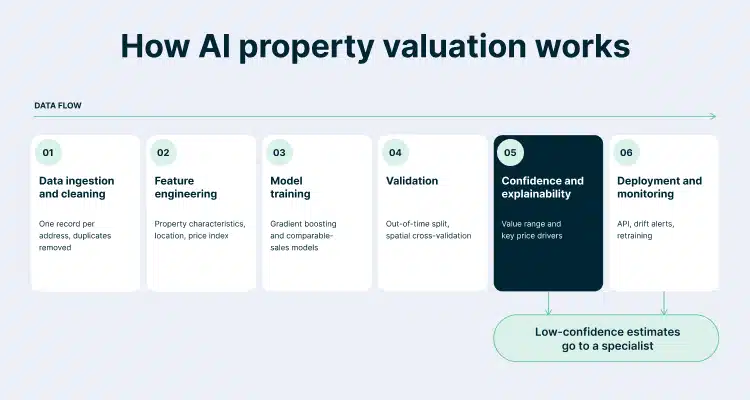
1. Data ingestion and cleaning
The system collects information about properties from various sources like public records, past transactions, listings, tax assessments, and maps. On top of that, property management platforms also add details like rental rates, how often properties are occupied, and booking history.
Engineers need to work on matching each piece of information to a specific address, getting rid of any duplicates, and marking anything that seems unusual, for example, when a property is sold to a family member. Forbytes considers accurate and clean historical property data as the first checkpoint for any model that estimates the value of a property.
Is Your Property Data Ready for AI?
Forbytes engineers audit the data in your PMS, CRM, or lending platform and show what a valuation model can use today and what to prepare first.

2. Feature engineering
Engineers take raw data and turn it into characteristics the model can use: floor area, age, layout, and condition. Your engineering team also makes sure a future model understands not only property features, but spatial features as well: how far a house is from public transportation, schools, and other amenities, and what the prices are like in the surrounding neighborhood. They even break it down into smaller areas, like a hexagonal grid. Developers also adjust past sales to current market levels with a price index.
3. Model training
When it comes to property data in tables, gradient boosting models are a good starting point. To make errors more consistent, teams usually train their models using price logarithm. This way, the errors are proportional for both cheap and expensive properties. In real-world systems, multiple AI models are often combined, such as a model that looks at similar sales and a gradient boosting model, with each one given a weight based on the type of property.
4. Validation
The team checks how well the model predicts prices for homes it hasn’t seen before. To do this, they use an out-of-time split, where the model is trained on old sales data and then tested on more recent sales. They also use a method called spatial cross-validation, which holds out entire neighborhoods to see how the model performs in new areas.
The team looks at a few key metrics, including the median absolute percentage error, which shows how far off the model’s valuation predictions are from the actual sale price, and the percentage of estimates that are within 10% of the sale price. They track these metrics for different regions and types of properties. Additionally, they do segment-level checks to make sure the model is fair and doesn’t discriminate against certain groups.
5. Confidence scoring and explainability
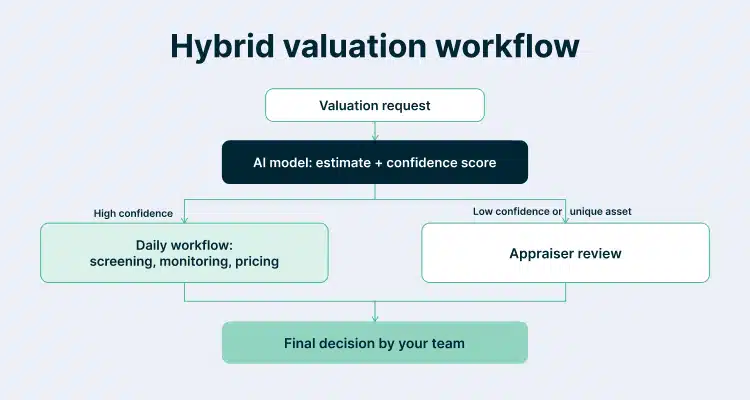
When engineers use quantile regression or conformal prediction, they get a range of values for each estimate. If the range is small, that means the team is pretty sure about the answer. SHAP values help the development team understand how each feature affects the price, so they can see why the model came up with a certain number. If the model is not very confident about an estimate, it sends it to a specialist for a closer look.
6. Deployment and monitoring
The model works in the background, accessed through an API, and it can run in two different ways: one for looking at a whole portfolio at once, and another for handling individual requests in real time. To keep everything up to date, a feature store makes sure the data used for training and serving is consistent. There’s also a monitoring system that checks for any changes in the data and how accurate the model is with new property sales. Before a new version of the model is released, it’s tested against the current one in a setup known as champion-challenger to ensure it’s working as expected.
Some teams add an AI agent on top of this pipeline. The agent pulls comparables, drafts a valuation summary, and flags anomalies. A specialist reviews and approves each output.
AI Valuation and Traditional Real Estate Appraisal: When Each Fits Best
Both methods have a place in real estate operations. The right choice depends on the decision, the asset, and the regulatory context.
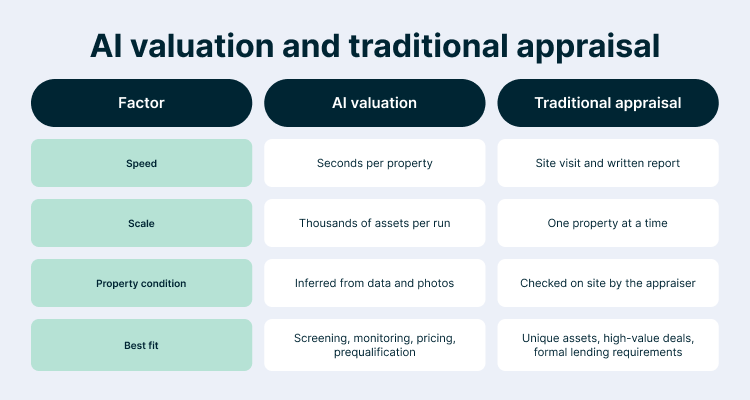
Speed
An AI model performs only as well as the data behind it. When a request is submitted, the model executes a calculation and generates an estimated value, accompanied by a confidence score. You can rely on an AI-driven approach for daily tasks; however, only if your data is well-prepared for AI integration.
For example, the Forbytes team centralized the data, standardized terms across brands, and gave every field a clear business definition to make the data system of a multi-brand group AI-ready. That groundwork made data from all 50+ brands structured and AI-readable. A valuation model needs the same preparation: consistent property data and one shared definition for every field.
Traditional valuation is based on a different type of process: an appraiser schedules a visit, inspects the property, selects comparable sold properties, manually adjusts the data for each one, and compiles a report, which often has a review process. Since each of these stages requires human involvement and the coordination of schedules, the turnaround time can vary based on the volume of requests and the time of year. Exceptional cases or scenarios requiring a closer, expert-level assessment benefit more from this traditional approach.
Scale
AI-driven valuation scales alongside computational power. You can value a single property or an entire portfolio in a single batch process using the same model.
In contrast, traditional valuation scales by adding human resources. Since every property requires an appraiser’s time, revaluing a portfolio entails completing hundreds of individual tasks. For lenders, property managers, and investors who track large portfolios and must analyze vast amounts of data, this fact determines the frequency with which they can update asset value information.
Property Condition
Artificial intelligence models determine the condition of a property based on available data, such as photos in a listing, property descriptions, permits, and the building’s age. This works when the information is provided and is up to date. However, the system may fail to account for changes not reflected in the data, for instance, recent renovations, hidden damage, or an unregistered extension. An appraiser visiting the property in person can observe such details firsthand, take measurements, and adjust the valuation accordingly.
For this reason, many lenders and companies prefer to combine both approaches: a qualified inspector collects data on-site and notes any discrepancies, while an AI model analyzes this accurate, current information to calculate the value.
Best Fit
AI valuation fits decisions that need speed and volume: screening deals, monitoring portfolios, pricing listings, and prequalifying borrowers.
Traditional appraisal fits cases with high stakes or little data. Unique properties have few comparable sales, so models have less to learn from. High-value deals justify the cost of a detailed review. Many lending transactions also require a licensed appraisal by rule, and in the US, lenders that use AVMs in credit decisions must apply federal quality control standards.
Based on our experience and the cases we have seen, sometimes a mix of both is the best option. AI valuation tools can handle the usual cases in your team’s daily working routine, while the appraiser steps in for the ones that require a closer look or a specialist’s opinion.
How to Add AI Valuation to Your PMS, CRM, or Lending Platform
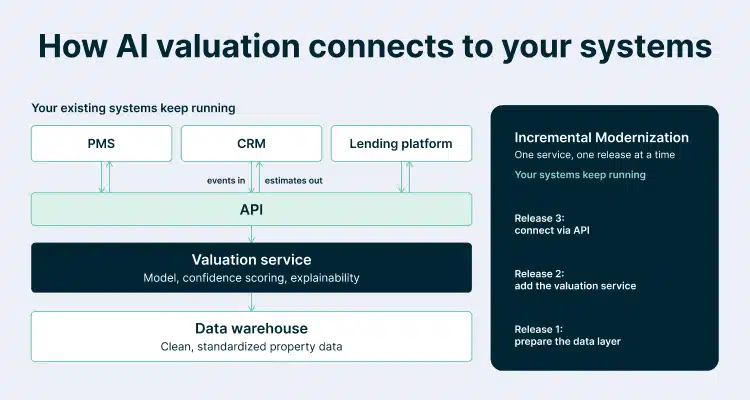
You already have a lot of the information a model needs in your current systems. Forbytes suggests adding AI valuation as a separate service that connects to the core platform. This way, current workflows keep running while the new feature goes live, and your team controls each step of the rollout.
1. Audit your data and define the use case
Take a look at what each system already stores. For instance, a PMS typically stores rates, occupancy details, booking history, and maintenance records. Your CRM system holds information like property listings, deal prices, and client interactions. A lending platform holds collateral records, past appraisals, and underwriting decisions.
Map these sources, check them for missing information or inconsistent fields, and choose one decision the model should support first.
2. Prepare the data layer
A valuation model needs one clean source of truth. Data engineers centralize records in a data warehouse, match each property to a single address, and give every field one shared definition.
3. Set valuation accuracy threshold and the specialist’s role in review
Agree on the error level you accept for each market and property type before launch. When you’re getting ready to launch, decide what level of error you’re okay with for each market and type of property. Set a threshold for how confident you need to be in your estimates — if they’re above that line, they can go straight into the workflow, but if they’re below it, they need to be reviewed by a specialist.
It’s also a good idea to log every model output and every human decision. This audit trail supports quality control rules for AVMs in the US and the RICS standard in the UK.
4. Pilot on one market or portfolio segment
Start by running the model in a test mode. This approach will give you estimates to compare with your current sales prices or appraisals. Your team can then check how accurate these estimates are. Once the model meets the threshold on one segment, it goes live there and expands to the next one.
Test AI Valuation on Your Own Data
Start with one market or portfolio segment. Our team scopes the pilot, sets the accuracy threshold with your specialists, and compares every estimate with real sales.

5. Integrate via API into your existing PMS or CRM through incremental modernization
The valuation service exchanges data with your platform through APIs. When new transactions happen, they’re sent to the model as events, and the estimates are then shown on the screens your team is already using.
Forbytes applied the same phased approach in its modernization work for Guesty, a property management platform. Our team moved one domain at a time out of a legacy codebase into separate services, and the platform kept serving users throughout. For the best results, both API integration and software modernization should follow the same order: one service, one release, one verified result at a time.
6. Monitor performance and retrain the model
For the model to provide you with the best results, track accuracy against new sales on a dashboard, set alerts for data drift, and retrain the model on fresh transactions. A specialist should review each retrained version before it replaces the live one.
Your Next Step
Successful AI use starts with clean data and one clear first use case. Forbytes engineers help real estate firms, property managers, and lenders leverage AI inside the platforms they already run. We audit your property data, build custom AI tools for your markets, and connect them to your PMS, CRM, or lending platform one release at a time. Your specialists keep the final call on every valuation. Book a consultation with Forbytes to plan your AI implementation and choose the AI solutions that fit your real estate operations.
FAQ
What is AI property valuation?
AI property valuation uses AI and machine learning to estimate a property’s market value from sales history, property characteristics, location data, and market trends. The model returns an estimate and a confidence score in seconds. A specialist reviews estimates the model is unsure about.
How accurate is AI property valuation?
Accuracy depends on data coverage, property type, and market activity. Clean, current data is the basis of every accurate valuation. Standard residential real estate in active markets gets the most accurate property valuation, because the model has many comparable sales to learn from. Unique properties and rarely traded assets need a specialist’s review.
What are AI property valuation tools used for?
Teams use AI property valuation tools for portfolio monitoring, listing property prices, deal screening, and loan prequalification. Typical users include real estate investment firms, lenders, property managers, and every real estate agency that offers instant estimates to clients.
How do real estate agents use AI for property valuation?
Real estate agents use AI for property valuation to price listings, prepare comparative market analyses, and give sellers a first estimate at the initial meeting. Estate agents review each figure before they share it with a client.
Does AI property valuation software work for commercial real estate?
Yes. Commercial real estate AI models add income data, lease terms, and occupancy to the standard inputs. They perform best for asset types with enough comparable transactions, and specialists review the rest.
Can AI predict future property values?
Property valuation AI can forecast future property values from price trends, supply data, and local economic signals. Forecasts carry wider confidence ranges than current estimates, so teams use them for planning and treat them as scenarios.
Should we build custom AI or buy an off-the-shelf valuation tool?
Ready-made AI tools fit standard use cases and common markets. Custom AI fits companies with proprietary data, niche asset types, or a platform that needs deep integration of AI into existing workflows. Forbytes recommends a pilot to compare both options on your own data.
What is the future of AI in property valuation?
The future of AI in property points to continuous, explainable valuation. AI for real estate will combine imagery, building data, and AI agents that draft reports for specialist sign-off. AI is transforming real estate pricing, and it can revolutionize real estate workflows built on manual research, enhancing property assessment at scale.
Share:
-

-
-
Successfully copied
-




Daryna Hanhur
Content Writer
My role is to make Forbytes’ expertise, which spans over a decade, noticeable to others. I believe that good content should make one thing clear: how the team solves real problems. That is why, as a content writer, I focus on highlighting the business value of Forbytes’ projects, the technologies used, and the challenges overcome.







Let's Get in Touch




Forbytes created an app that allowed users to quickly measure themselves to be fitted for custom shirts. As a result, we could increase our speed, quality, and shirt output per week. Forbytes was dedicated to delivering a solution that accurately addressed our needs.

Forbytes’ engineers and team leads worked as part of our RnD group and were directly managed by our company directors. They were both proactive and adaptable, qualities that perfectly match our needs in our fast-growing and constantly evolving environment.

Forbytes has a strong process-oriented way of leading the company, with good respect for themselves and their managers. They made a choice not to become too big but build slowly on more qualified people, which is paying off.

Niklas Hammar
COO & Business
Development at Offerta.se

Our e-commerce site saw online inquiries and orders rise after working with Forbytes. The team used top-notch expertise to inform their suggestions and improvements. Constant communication, quick responses, and prompt delivery made for a smooth and enjoyable collaboration.

The Forbytes team was very professional and demonstrated a great understanding of the business aspects. All tasks were completed above expectations. Their experts were always available, and we never needed to wait for a response or a suggested solution.